January 5, 2026 · Updated April 3, 2026 · Vedanshu Jain
Agentic AI for E-Commerce: Beyond Chatbots and Content Generation | Urumi.AI
Learn how we at Urumi.AI we are building agentic AI eCommerce that can be used beyond chatbots and creating content.
Agentic AI is very much in news for eCommerce. This is especially important for open source projects like WooCommerce or MedusaJS where AI can go much deeper and wider.
At Urumi.AI we are building agentic AI eCommerce that can be used beyond chatbots and creating content.
The Author was a core WooCommerce developer – The eCommerce platform used by 30% of all eCommerce sites on the internet.
What is Agentic AI?
When you search for “AI for eCommerce” or “AI for WooCommerce”, the first page is very predictable. It would all be about chatbots, creating content and how will they fix your customer support.
They are all useful, but none of them solves actual problem.
When checkout starts timing out, after months of theme degradation, you don’t open the site chatbot. When an integration between Meta Ads and order attribution breaks, no content generator helps. When you want to debug shipping calculations issues, those AI tools just watch it happen.
Often, this means having to call a developer or an expert, which means paying $150/hour. They fix it. Three months later, something else breaks, maybe it’s the same issue creeping back, maybe it’s something new. You call them again. Every eCommerce store owner knows this cycle.
After co-developing WooCommerce and watching millions of merchants navigate these same challenges, we built Urumi.AI to solve a different problem: What if AI could actually run your store, not just respond to customers or generate content, but handle the continuous technical maintenance that keeps breaking your momentum
Actually fix things, without you opening a support ticket or hiring another developer.
This is what “agentic AI” actually means. And it requires a level of integration with the eCommerce platform that goes far beyond what most AI tools offer.
We are going to go deeper into what separates true agentic AI from the valuable-but-limited tools already in the market. More importantly, it shows what becomes possible when AI can safely access your code, your database, and your configuration and not just your storefront.
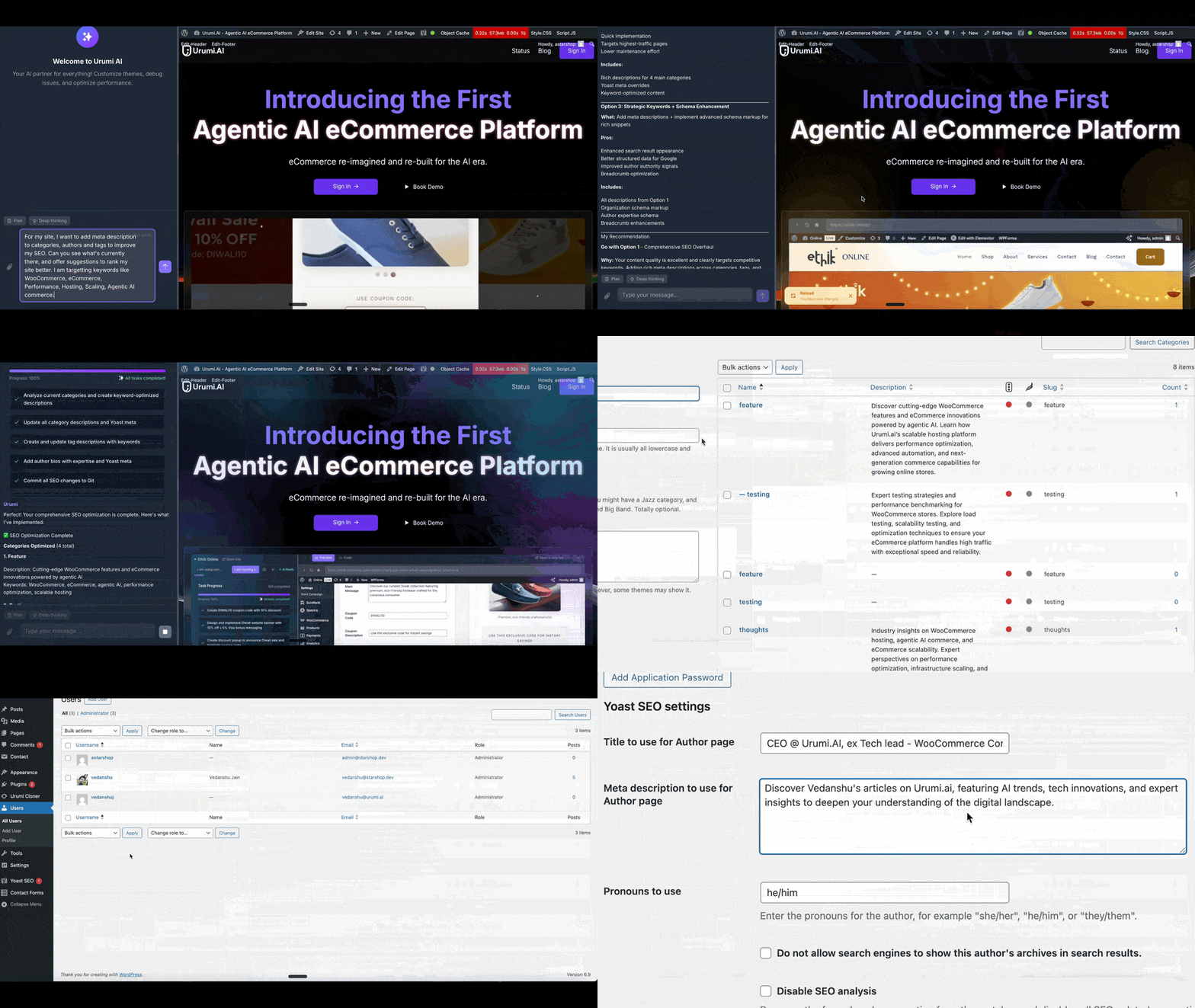
For instance, when we wanted to add SEO description to all our categories tags and authors on our newly created site, we asked the AI agent to add it.
Why Current AI Tools Don’t Run Your Store?
(Hint: It’s About Safety)
Current AI tools stick to customer service and content generation for a good reason: it’s safe. A chatbot giving a wrong answer is a minor issue. A content generator producing mediocre copy can be edited.
But AI that modifies your database? Alters your code? That’s genuinely risky if not done right. One wrong database query can corrupt orders. One bad config change can take your site offline.
This is why most AI tools in e-commerce deliberately avoid deep operational integration. It’s not a technical limitation, it’s a safety consideration. And they’re right to be cautious if they don’t deeply understand the underlying architecture.
This is also why experience building the most popular eCommerce platform matters. We know exactly what can break, and how to make changes safely.
But knowledge alone isn’t enough. Safe operational AI requires a system of safeguards.
Our safety architecture was designed by team members who built safety systems for billion-user products at WhatsApp, Instagram, and Facebook. When you’re making automated changes at that scale, you work from very sound principles and discipline. The systems that keep those platforms stable are the same principles we’ve applied to Urumi.AI.
Along with guardrails on what AI can and can’t do, all changes are classified. Not all modifications carry the same risk. Cleaning expired database cache is low-risk and reversible. Modifying payment gateway configuration is high-risk and requires different protocols. The system categorizes every potential change and applies the appropriate level of caution.
fter any change, the system monitors key metrics: site response time, error rates, checkout completion, order processing. If anything degrades, rollback happens automatically, not after you notice a problem, before customers are affected.
This level of integration is only possible on open source platform like WooCommerce
Consider Shopify: their platform is closed by design. You cannot modify the admin panel. You cannot access the core database directly. You cannot change platform-level configurations. AI tools on Shopify are limited to what their API exposes, which is by design for safety and standardization. It’s a reasonable tradeoff for a managed platform, but it means operational AI can’t exist there.
Even with other WooCommerce hosting providers, the AI can’t make direct production changes. Most managed WordPress hosts would not and could not take accountability for direct database access, file system modifications, and configuration changes through automated systems. Again, this is a reasonable security policy, but it prevents deep operational automation.
Urumi.AI works because of the unique combination: WooCommerce’s open architecture + self-hosted control + safety systems proven at billion-user scale.
You maintain full ownership of your store, your data, and your code. But our AI agents can operate at the infrastructure level, making the kinds of changes that typically require developer access, because we’ve built the safety layer that makes it responsible to do so.
What agentic AI actually does?
Performance audit and fixes
A cosmetics company’s WooCommerce site kept getting slower. They wanted to try out Urumi and asked a simple question: “Why is my site slow?”. The agent did an analysis and revealed the typical culprits that accumulate over time: product renders doing expensive computations without cache. In their case, it was coming from a vendor plugin, but the agent was able to fix it all the same.
Page loads: 4.1 seconds to 0.8 seconds.
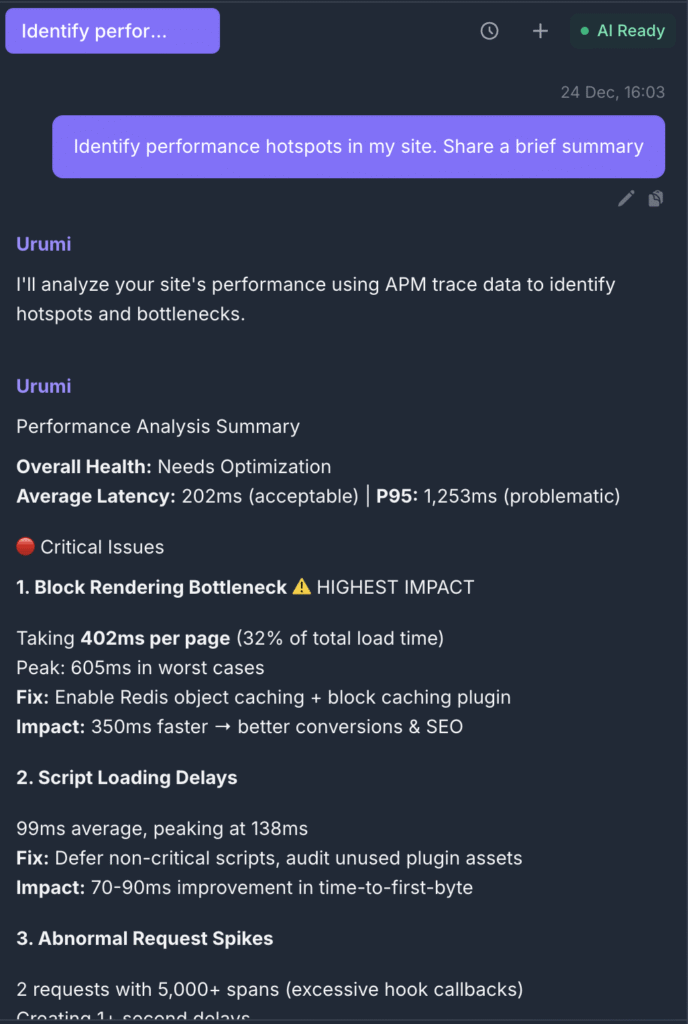
Now monthly analyses catch these issues before they compound. No more sudden performance crashes.
CSS and JavaScript issues
We’d let the GIF above do the talking, agentic AI can indeed work really well with content. With Urumi.AI: point to what’s broken, the system identifies the identifies the requirements, implements the fix. It is that simple.
Usually these issues are fixable, but not without technical knowledge or know-how. Traditional debugging means screenshots, detailed reports, hoping the developer can reproduce the issue. Multiple emails and days of waiting.
The Plugin Dilemma
Needing one specific feature often means choosing between bloated solutions or expensive custom work.
Example: a pilot store needed B2B pricing logic that no existing plugin handled correctly. The nearest alternative offered that feature buried among dozens of others, adding database overhead and complexity.
Urumi.AI built a lightweight plugin with exactly the required functionality. Essentially, different prices for B2B customers vs retail customers. No excess features. No performance penalty. When business rules changed later, the system adapted the code automatically.

Maintenance that prevents problems
There’s the recurring maintenance work that store owners usually handle manually or pay for specialized tools to manage.
Need to reorganize your product catalog? Ask to consolidate duplicate tags that have accumulated over months. The system reviews your taxonomy, identifies duplicates and inconsistencies, and cleans them up.
Notice your product categories have gotten messy after multiple team members added products? Request a category audit. The system analyzes your catalog structure, flags products in wrong categories, suggests better organization based on attributes and existing patterns.
Product SEO needs attention? Ask for an SEO review. The system scans for duplicate meta descriptions, missing alt text, thin product content, broken internal links. Shows what needs fixing and can implement the corrections.
Wondering which products aren’t performing? Request inventory analysis. The system identifies SKUs with low movement, incomplete information, or poor descriptions-products that might need price adjustments, better content, or removal.
These are capabilities that Shopify Plus merchants get through advanced admin tools or third-party apps, often at significant monthly cost. On WooCommerce, they typically require manual work, expensive plugins, or custom development.
With Urumi.AI, ask for what you need: “Clean up my product tags,” “Find products with missing descriptions,” “Show me items that haven’t sold in 90 days.” The system handles it and reports back what was done.
Over time, it learns merchant preferences. How products should be categorized. Which tags matter. SEO patterns that work for the specific catalog. Context that would need explaining to each new team member or contractor.
Why WooCommerce (and Why Now)
This approach of agentic AI with deep operational access only works on open source platforms like WooCommerce and MedusaJS. Here’s why that matters.
Control Without the Burden
You chose WooCommerce for ownership and flexibility. You wanted to control your data, customize without restrictions, and avoid platform fees eating into margins. But that control came with responsibility: performance optimization, security updates, plugin conflicts, database maintenance, integration fixes.
WooCommerce’s open-source, self-hosted architecture is what makes operational AI possible. The AI can access your database directly, modify configuration files, adjust code, optimize queries, everything a developer with full access would do. Shopify’s closed platform doesn’t allow this level of integration, even if you wanted it. The APIs expose limited functionality by design.
This isn’t a limitation of Shopify, it’s a reasonable tradeoff for a managed platform prioritizing stability and standardization. But it means operational AI that can truly manage your store’s technical infrastructure can’t exist there.
With WooCommerce, you keep full ownership and control. But the technical burden that traditionally comes with self-hosted e-commerce? That gets automated.
Built by People Who Built WooCommerce
We didn’t just use WooCommerce extensively, we were the core developers. We led the HPOS project, the fundamental redesign of how WooCommerce handles order data at scale. We know where performance bottlenecks typically appear because we architected those systems. We understand how plugins interact with core functionality because we designed those integration points.
This matters because operational AI needs to know not just what changes to make, but what changes are safe, what dependencies exist, and what might break downstream. That knowledge doesn’t come from documentation or tutorials, it comes from building the platform.
For your store: faster diagnosis, more accurate fixes, solutions that account for WooCommerce-specific behaviors that might not be otherwise obvious to developers less familiar with the platform’s internals.
Why This Exists Now
This approach couldn’t have existed three years ago. Three things had to converge:
AI capabilities matured. Modern language models can write production-quality code, understand complex technical systems, and reason about architectural decisions. Earlier AI couldn’t do this reliably enough for production environments. This capability emerged in the last 18-24 months.
E-commerce operations became more complex. WooCommerce stores today run sophisticated operations, inventory systems syncing across platforms, dynamic pricing rules, multiple payment gateways, shipping integrations, marketing automation, analytics pipelines. This complexity demands expert-level technical management.
Infrastructure became fully programmable. Hosting providers, CDNs, monitoring tools, payment processors, everything has APIs now. An AI agent can orchestrate across these systems in ways that required extensive custom integration work just a few years ago.
The convergence of these three factors in 2024-2025 created the conditions for operational AI in e-commerce to become practical.
You’re not paying someone to learn WooCommerce or figure out your setup. You’re paying for solutions.
What’s next
Urumi.AI is already powering WooCommerce stores, merchants who are running with very lean teams and needed a better way to manage their technical operations. They’re seeing the results: faster sites, fewer support tickets, issues caught and resolved before they impact customers.
The stores using Urumi.AI range from specialized retailers to high-volume operations, all sharing the same challenge: they need expert-level technical management but don’t want to inflate the team size too much or pay for fixes to recurring problems.
This works because the safety systems are proven, the AI makes accurate diagnoses, and the fixes are reliable. But more importantly, it works because we built WooCommerce and understand it at a level that makes operational AI possible.
Who This Is For
This makes sense for WooCommerce store owners who:
- Want to keep their teams lean
- Want functionality beyond core WooCommerce without installing bloated plugins
- Value control over their store but don’t want the technical burden of self-hosting
- Need continuous technical management, not just periodic fixes
If you’re running a WooCommerce store and technical maintenance has become a bottleneck, whether that’s time, cost, or just the overhead of managing it, this approach might fit.
Let’s Talk
Book a demo call to discuss whether Urumi.AI makes sense for your store. We’ll look at your current setup, understand what’s frustrating you, and be honest about whether we’re a good fit.
Book Demo Call – Calendar Link
Where This Is Heading
Operational AI for e-commerce is just beginning. Chatbots and content generators were the first wave-useful but limited. The next wave is AI that actually manages your store’s technical operations.
WooCommerce’s open architecture makes this possible. The timing is right. The need is real.
If you’ve been waiting for AI that does more than talk to customers or write product descriptions, that actually handles the technical work of running an online store, this is it.
Built by ex-Automattic WooCommerce core engineers
We built WooCommerce core at Automattic — the parts that matter in production: performance, payments, reliability. Earlier we were founding-era engineers at HackerRank (Y Combinator), where the team scaled the company from $2M to $30M ARR. That's why we can operate your store end-to-end, not just host it.
Run your store on Urumi.
Production-ready today. Built for high-traffic WooCommerce stores where downtime moves revenue.
See the WooCommerce platform · Talk to founders
Agent live · 99.99% uptime · shipping today.
🦷 Can you believe it? This page was built by a dentist using urumi.ai