 Urumi.AI
Otta vs Medusa: A Medusa Alternative That Runs on Cloudflare Workers
Can Medusa run on Cloudflare Workers? Its backend needs Node.js, Postgres and Redis. Otta runs commerce inside EmDash on Workers. The trade-offs, sourced.
Medusa’s backend needs two Node processes, PostgreSQL and Redis. Otta runs a store in one Cloudflare Worker. Here is what each design gets you.
Updated 2026-11-21 · Disclosure: Urumi builds Otta. Medusa facts link to their sources with the date we checked them. If we got something wrong, open an issue and we will correct it.
Can Medusa run on Cloudflare Workers?
Not today, as of 2026-11-21. Medusa’s backend is built as long-running Node.js processes that need PostgreSQL and Redis (Medusa deployment docs), which is a different shape from a Worker. A common pattern is a Workers storefront with the backend on Medusa Cloud or a Node host. Otta is a different design: commerce runs inside the EmDash CMS on Workers.
Otta is an open-source commerce plugin for EmDash that runs products, cart, checkout, orders and inventory inside the CMS on Cloudflare Workers, with no separate backend, database server or Redis.
In one line: Medusa is a headless Node.js commerce backend that needs PostgreSQL and Redis; Otta is an EmDash plugin that runs in one Cloudflare Worker with D1.
| If you… | Otta |
|---|---|
| Need multi-region pricing, sales channels or multi-warehouse stock | Not available. Medusa has modules for these. |
| Need RBAC or SSO for a team | Not available. Both are Medusa Enterprise Edition features. |
| Have a Next.js, mobile or POS frontend | Not a fit. Otta is not a backend for arbitrary frontends. |
| Want a managed backend with support and autoscaling | Not available. Medusa Cloud starts at $29/month (pricing, 2026-11-21). |
| Run (or plan to run) your site on EmDash and want one admin for content and products | Recommended |
| Want the whole store in one Cloudflare Worker | Recommended: $0 for the Worker on Workers Free, with the email and R2 limits below |
| Want fully managed SaaS and no code at all | Not a fit. Otta is code you deploy and run. |
The quickest way to see Otta is to try the Otta playground: a disposable store that lasts about an hour, with no account and no card payments. EmDash ecommerce: how to add a store covers the plugin in more depth.
What are the main Medusa alternatives?
The open-source alternatives to Medusa differ mostly in runtime and database: Saleor is Python with PostgreSQL, Vendure is Node.js with a SQL database, Bagisto is PHP with MySQL, and Swell is hosted SaaS. Otta is the only one here that runs inside a CMS on Cloudflare Workers. All rows checked 2026-11-21.
| Platform | Runtime | Database and services | License | Source |
|---|---|---|---|---|
| Medusa | Node.js (v22.22.0+), two processes: server and worker | PostgreSQL and Redis in production | MIT (RBAC and SSO are Enterprise) | deployment guide |
| Saleor | Python 3.12, Django | PostgreSQL; Celery workers with a Redis or SQS broker | BSD-3-Clause | pyproject.toml |
| Vendure | Node.js v22, v24 or v26 | PostgreSQL, MySQL, MariaDB or SQLite | GPLv3, or a commercial license on paid plans | installation docs, README |
| Bagisto | PHP 8.3 or 8.4, Laravel | MySQL 8.0 or MariaDB 10.11 (PostgreSQL 16 only after the 2.4 release line); Redis and Elasticsearch optional | MIT | requirements |
| Swell | Hosted by Swell (not self-hosted) | Managed by Swell | Commercial SaaS; plans from $29/month billed yearly | pricing |
| Otta | One Cloudflare Worker, inside EmDash | D1, R2, KV; no Postgres or Redis | MIT | README |
If you need a general-purpose headless backend for any frontend, the fair comparison is Medusa, Saleor and Vendure. Otta only belongs on this list if your site runs on EmDash. Other EmDash commerce plugins exist too, including Vendwick, DashCommerce, Catalog Studio and Ritely; Best EmDash Plugins (2026) covers them.
What does Medusa need to self-host?
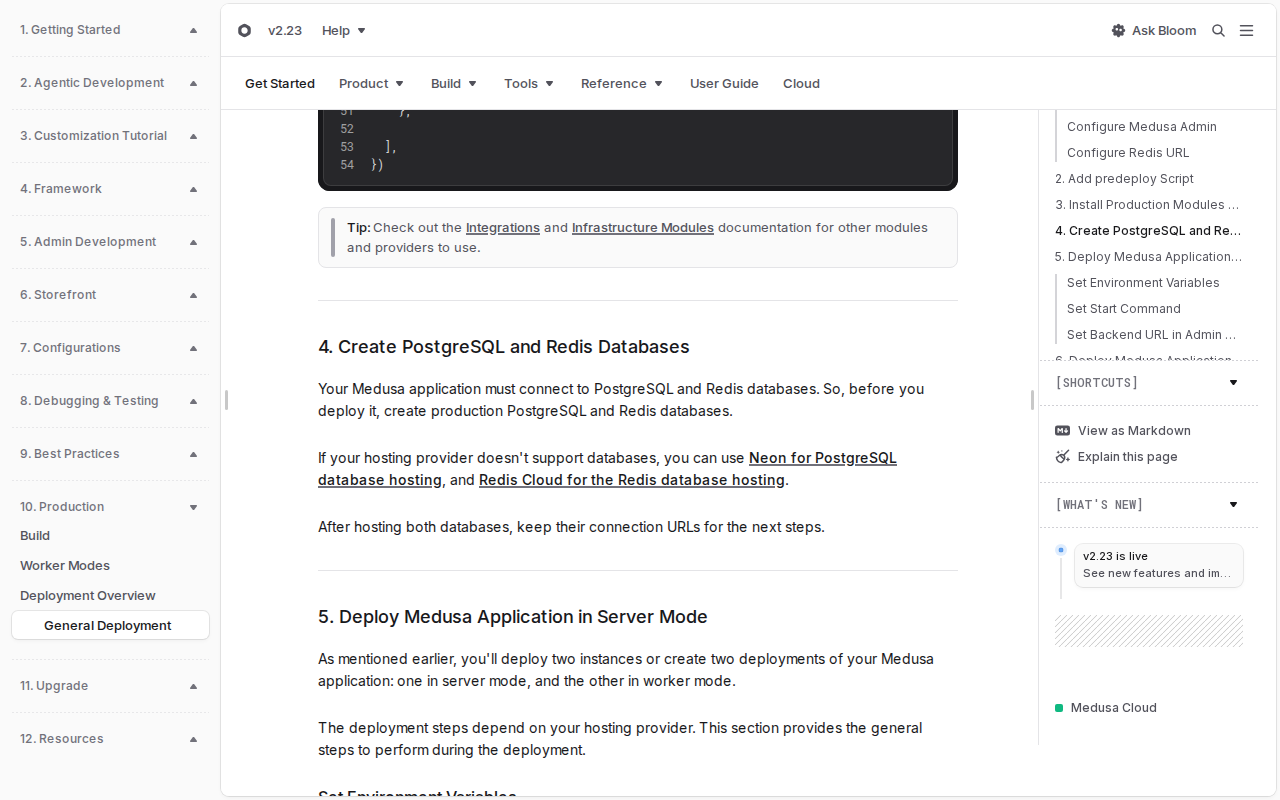
A self-hosted Medusa store needs two deployments of the same app, one in server mode and one in worker mode, plus a PostgreSQL database and a Redis database, on a host with at least 2 GB of RAM. That is what Medusa’s general deployment guide said on 2026-11-21. In its own words:
- "When you deploy the Medusa application, you deploy two instances: one in server mode, and one in worker mode."
- "The server mode handles incoming API requests and serving the Medusa Admin dashboard." "The worker mode handles background tasks, such as scheduled jobs and subscribers."
- "Your Medusa application must connect to PostgreSQL and Redis databases."
- "Redis database: This is the database that will store the Medusa server’s session."
- "for optimal experience, the hosting provider and plan must offer at least 2GB of RAM."
So Redis is not optional in production: Medusa’s own guide makes it the server’s session store. Vercel’s Deploy Medusa on Vercel guide (2026-09-29) adds that "Redis backs the Event, Workflow Engine, Locking, and Caching modules in production." Those are Medusa’s infrastructure modules. Medusa also publishes in-memory and Postgres versions of some of them (@medusajs/event-bus-local, @medusajs/workflow-engine-inmemory, @medusajs/locking-postgres, all at 2.23.0 on npm), so Medusa can run without Redis in development.
The guide says "The best way to deploy Medusa is through Medusa Cloud". We searched Medusa’s deployment overview and general guide on 2026-11-21 for "Cloudflare", "serverless" and "edge" and found no mention, so Medusa does not claim Workers support for its backend in the docs we read.
How are Medusa and Otta built differently?
Medusa is an MIT-licensed headless commerce backend for Node.js that you pair with a separate frontend and, often, a separate CMS. Otta is commerce for EmDash: it runs inside the CMS, so content and commerce share one Cloudflare Worker and one D1 database.
Medusa builds that backend from modules. In Medusa’s docs: "A module is a reusable package of functionalities related to a single domain or integration." EmDash plugins work differently: a plugin can run sandboxed in its own isolate or in-process with the site. Otta’s one-click template runs it in-process, so it does not get sandbox isolation there.
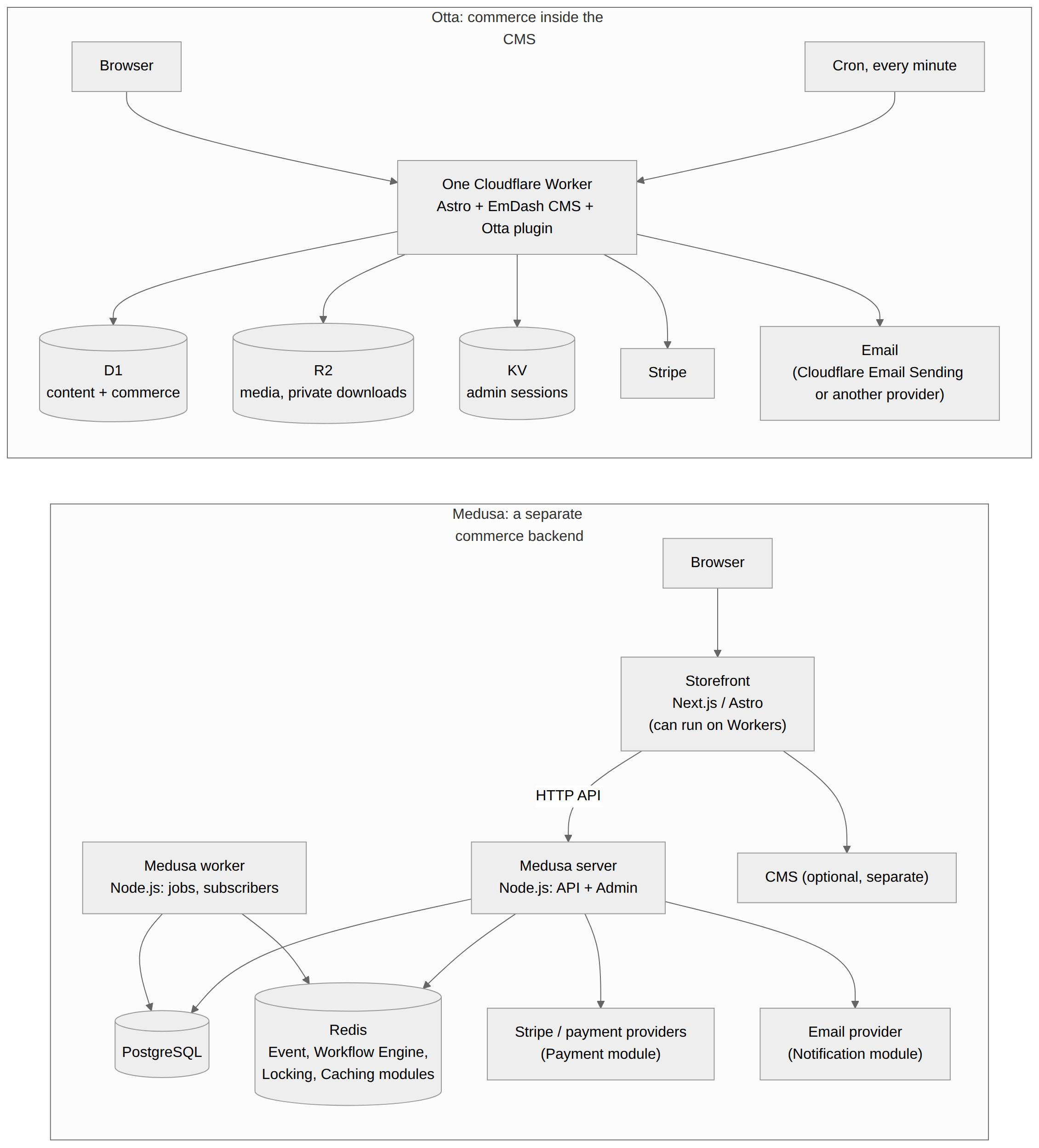
Medusa’s shape. A storefront (Next.js, Astro or anything else) calls the Medusa server’s HTTP API. The server hosts the API and the Medusa Admin. A second Medusa process in worker mode runs background jobs and subscribers. Both use PostgreSQL and Redis. Payments go through Medusa’s Payment module and its providers (Stripe among them), and email through its Notification module. Content often lives in a separate CMS such as Sanity, Payload or Contentful.
Otta’s shape. The browser talks to one Cloudflare Worker that runs Astro (see Astro ecommerce options compared), the EmDash CMS and the Otta plugin together. That Worker uses D1 for CMS content and commerce records, R2 for media and private downloads, and KV for admin sessions. In the one-click template, a cron trigger runs every minute for background work. Outbound calls go to Stripe for card payments and to an email provider. The one-click template uses no Postgres or Redis. Postgres appears in the Otta repository only in a CI test harness that runs the same storage code against it.
The trade-off of one Worker. Content and commerce share one deploy, one failure domain and Cloudflare’s per-request CPU limits. A bad deploy or a CPU-heavy page affects the shop and the content together.
Why this fits Workers. A Worker is billed and limited on CPU time, not wall-clock time. Cloudflare’s limits page says: "Waiting on network requests (such as fetch() calls, KV reads, or database queries) does not count toward CPU time." Workers Free allows 10 ms of CPU per request (checked 2026-11-21). Otta’s work is built around D1 reads and writes, whose wait time does not count as CPU. We have not measured its CPU time per request. Medusa’s design suits a different model: long-running servers that hold connections and run background jobs, which is a sound choice for its workloads and is why it runs on Node hosts.
What in-process means. Otta keeps commerce state in EmDash’s per-plugin document store. Each cart, inventory and order record is one document updated with compare-and-set: a write states which version it read, and if another write got there first it re-reads and retries. Atomicity is per document. A step that touches several documents is written so it can be safely restarted, and the every-minute cron finishes any step that was interrupted. The design is recorded in a design note.
What you give up and what you get by putting commerce inside the CMS
Putting commerce inside the CMS trades breadth for fewer moving parts.
- You get: one deploy, one admin for content and products, one database (D1), and no Node server, Postgres or Redis to run.
- You give up: a standalone commerce API for other frontends, multi-document transactions (Otta’s atomicity is per document), and portability beyond EmDash.
- You share: one failure domain and one set of Workers CPU limits between your content and your shop.
If those trade-offs fit a single EmDash store, the design is simpler to run. If they do not, Otta is not a fit.
Otta’s agent tools follow the same in-CMS design: the opt-in @urumi.ai/otta-mcp package exposes store admin over EmDash’s MCP endpoint, with no extra service to host, and writes go through the same guarded operations as the admin. An agent you authorize can create and edit product content with EmDash’s own content tools, and use Otta’s to set prices and stock and manage orders, coupons, shipping, tax and settings. A person still owns the Cloudflare account, claims the admin with a passkey, connects Stripe and approves what ships.
Medusa on Cloudflare: three real architectures
You can put a Medusa store on Cloudflare today, as long as the Medusa backend runs somewhere else. These three setups are public, and each row says what runs where (checked 2026-11-21).
| Architecture | What runs on Cloudflare | What runs elsewhere | Example |
|---|---|---|---|
| Workers storefront + Node backend | Astro or Next.js storefront | Medusa server, worker, PostgreSQL, Redis on Medusa Cloud or a Node host | Astro Medusa Storefront theme (Cloudflare Workers adapter); David Bartalos’s Astro + Medusa shop (storefront on Cloudflare Pages) |
| Payload on Workers + Medusa | Next.js storefront and Payload CMS, with D1 and R2 for Payload | Medusa backend on Medusa Cloud or self-hosted | Meridian (casualchic/medusa-payload-cloudflare) |
| Commerce in-process (not Medusa) | Everything: Astro, EmDash, Otta, D1, R2, KV | Stripe and an email provider | Otta one-click template |
The hybrid path works, and it uses each runtime for what it does well. Meridian’s README says "You need a Medusa backend" (Medusa Cloud or self-hosted), lists a "Cloudflare account ($5 paid workers plan)" as a prerequisite, and names Workers issues it worked around, such as "Workers can’t read files at runtime". Its $5 figure covers the Cloudflare side; the Medusa backend is billed separately.
What does each cost to run?
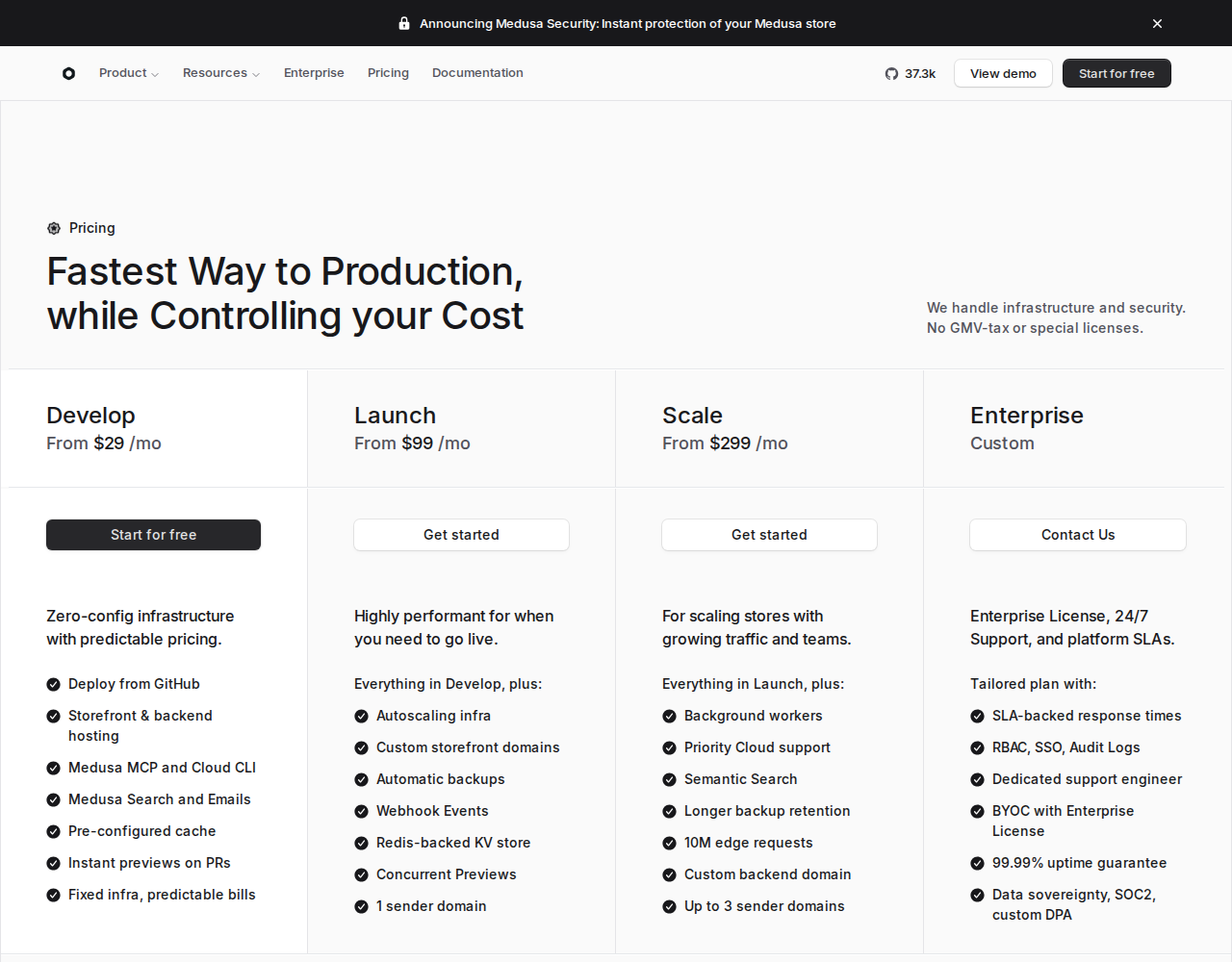
Medusa Cloud starts at $29 a month and Otta can start on Cloudflare Workers Free at $0 for the Worker, but they buy different things. Medusa Cloud is a managed service with Postgres, support and autoscaling; Workers Free is a self-service plan with hard daily caps. The prices below are not like-for-like. Disclosure: Urumi builds Otta.
| Option | Price | What it includes | Last verified |
|---|---|---|---|
| Medusa Cloud Develop | from $29/month | 600 compute hours/month, capped per environment; 1 shared server; Postgres 1 GB-month, then $0.50/GB-month; no Redis | 2026-11-21 |
| Medusa Cloud Launch | from $99/month | 1,000 compute hours, then $0.16/hour; "2 shared servers, autoscaling"; Postgres 5 GB-month, then $0.50/GB-month; Redis | 2026-11-21 |
| Medusa Cloud Scale | from $299/month | 2,800 compute hours, then $0.16/hour; "2 servers and 1 background worker, autoscaling"; Postgres 10 GB-month, then $0.50/GB-month; Redis | 2026-11-21 |
| Self-hosted Medusa, one example | €3.29/month | One person’s setup: a Hetzner CAX11 VPS (2 vCPU ARM64, 4 GB RAM) running Medusa, PostgreSQL and Redis, with the storefront on Cloudflare Pages (David Bartalos, dev.to, 2026-05-18). Your own time to run the server is extra. | Published 2026-05-18; read 2026-11-21 |
| Otta on Workers Free | $0 | One Worker, D1, R2, KV, cron; R2 needs a payment method on the account; Cloudflare email only to your own verified addresses | 2026-11-21 |
| Otta on Workers Paid | from $5/month per account | Higher limits; 3,000 outbound emails/month included, then $0.35 per 1,000 | 2026-11-21 |
Sources: Medusa pricing, Cloudflare Workers pricing, Cloudflare Email Service pricing, all fetched 2026-11-21. The Medusa prices come from the pricing page text, not only the screenshot below. The €3.29 figure is the author’s own, from May 2026; we did not re-check the VPS provider’s current price.
Total for a small store (one store, low traffic, card payments, order emails to customers; payment processing fees excluded on both sides):
- Medusa Cloud: $99/month on Launch, the cheapest plan that includes Redis. Develop ($29/month) does not include Redis, which Medusa’s production guide asks for.
- Self-hosted Medusa: from a few euros a month on a small VPS, as in the example above, plus the time to run, update and back up the server, PostgreSQL and Redis yourself.
- Otta: $5/month on Workers Paid, which is what you need to email arbitrary customers through Cloudflare. $0 on Workers Free, but without customer email: the one-click template has no option for adding another email provider (card checkout on Free is not yet tested).
The Otta figure is infrastructure only. It leaves out a custom domain, a third-party email provider if you use one, D1 and R2 usage above the included limits, and your time to run EmDash and a storefront theme. Medusa Cloud’s $99 includes managed hosting, managed Postgres and Redis, support and autoscaling.
Neither side charges a cut of sales. Medusa’s pricing page says "Every plan has a 0% GMV platform fee" and "There’s no lock-in." Otta is MIT-licensed and has no fee. Cloudflare’s Workers Paid plan is billed "for a minimum charge of $5 USD per month for an account."
Workers Free limits, from Cloudflare’s pricing page on 2026-11-21:
- 100,000 requests per day
- 10 ms of CPU time per invocation
- D1: 5 million rows read and 100,000 rows written per day, 5 GB total storage
These limits change, so check the page before relying on them. Ecommerce on Cloudflare Workers: Run a Store Step by Step goes through them in detail.
Which features does each have today?
Medusa covers more commerce scenarios; Otta covers the core buy flow for a single store. Medusa lists 23 commerce modules (fetched 2026-11-21). The table maps the main ones. It does not map RBAC, Loyalty, Store Credit, Translation, Currency or Settings. Note that RBAC appears in Medusa’s module list, but Medusa’s license file says RBAC and SSO are Medusa Enterprise Edition features.
| Capability | Medusa (module) | Otta | Last verified |
|---|---|---|---|
| Products and variants | Product module | Yes, with variants | 2026-11-21 |
| Inventory | Inventory and Stock Location modules (multiple locations) | One stock count per SKU (design note); no stock locations | 2026-11-21 |
| Cart and checkout | Cart module | Yes | 2026-11-21 |
| Orders and refunds | Order module | Yes (design note) | 2026-11-21 |
| Customers | Customer and Auth modules | Accounts with magic-link sign-in (design note) | 2026-11-21 |
| Promotions | Promotion module | Coupons and discounts | 2026-11-21 |
| Tax | Tax module | Tax rates by country and region, plus a calculator hook (design note) | 2026-11-21 |
| Shipping | Fulfillment module | Shipping zones by country and region, with rates (design note) | 2026-11-21 |
| Digital downloads | Not a dedicated module | Yes, files kept in a private R2 bucket | 2026-11-21 |
| Regions and price lists | Region and Pricing modules | Not available (shipping zones and tax rates are by country/region, but there are no per-region price lists) | 2026-11-21 |
| Sales channels | Sales Channel module | Not available | 2026-11-21 |
| Payments | Payment module with providers, including Stripe | Stripe (cards) and cash on delivery | 2026-11-21 |
| Team roles | RBAC (Enterprise Edition) | Not available | 2026-11-21 |
Otta column checked against the Otta README, ADRs and source; Medusa column from Medusa’s commerce-modules docs. Both checked 2026-11-21.
Otta also ships reporting and an admin console inside EmDash, so products and content are edited in one place. Its storefront routes return JSON view models that the theme renders (design note), but they run as EmDash plugin routes in the same Worker, not as a commerce API for other apps.
What does Medusa offer that Otta does not?
Medusa covers broader commerce needs and frontends other than EmDash. Medusa describes itself as "The world’s most flexible commerce platform for agents and developers" (GitHub, 2026-11-21). It offers:
- Multi-region, multi-channel and multi-warehouse selling, through the Region, Sales Channel and Stock Location modules.
- Any frontend: Next.js, mobile apps, POS, or several at once.
- Relational data and transactions. Medusa sits on PostgreSQL, with workflows that compensate on failure. Postgres gives you transactions across tables and ad-hoc SQL, which Otta’s per-document model does not (design note).
- Deep customization through modules and workflows.
- Team access controls. Medusa’s ENTERPRISE-LICENSE.md says "RBAC (role-based access control) and SSO (single sign-on) are Medusa Enterprise Edition features." The rest of Medusa is under the MIT license.
- Maturity and backing: 37,349 GitHub stars (GitHub API, 2026-11-21) and a regular release cadence (v2.23.0 on 2026-11-20), from a company that sells Medusa Cloud and Enterprise support. Stars measure attention, not production readiness, but Medusa has a long production track record.
When do we recommend Otta?
As a Medusa alternative, we recommend Otta, which we build, when your site runs on EmDash and you want commerce in the same place. It suits you if:
- You want content and products edited in one admin.
- You want one deployable and one database, with no Node server, Postgres or Redis to run.
- You want to start on Workers Free with a one-click Deploy to Cloudflare button (card checkout on Free is not yet tested).
- You run a single store that takes cards, cash on delivery, or both.
- MIT-licensed npm packages and no platform fee matter to you.
What are Otta’s limits today?
Otta is production-ready today and pre-1.0. These limits, all from the README, matter most:
- Pre-1.0. APIs, storage document shapes, settings and admin screens may change between releases. Pin exact versions and review each update.
- EmDash versions. The current npm release needs EmDash 1.5.0 or later. The one-click template pins the matching version for you.
- Tied to EmDash. It is not a headless engine for any frontend.
- Delayed payment methods. Stripe methods that confirm days later (SEPA Direct Debit, ACH, Bacs, bank transfer) are not supported yet. The issue is open: #606.
- Large variant saves on Workers Free. Re-adding many sized variants with SKUs in one save fails past about 16 to 20 variants. The issue is open: #637.
- Email. Cloudflare says "Sending to arbitrary recipients requires the Workers Paid plan" (Email Service pricing, 2026-11-21). Workers Free can send only to verified addresses in your own account. On the one-click template, use Workers Paid with Cloudflare Email Sending; without an email provider, customer sign-in links are not sent.
- What has been verified. Stripe card checkout and cash on delivery are implemented and covered by the project’s automated tests. The one-click deploy was run end to end on Workers Free on 2026-11-10 (deploy, storefront, claim), on the template’s earlier release (EmDash 1.3.1, Otta 0.2.0).
If those limits are acceptable, deploy Otta to Cloudflare or read the code on GitHub.
How can you try Otta?
You can try Otta in the browser with no install, deploy it to your own Cloudflare account, or run it locally.
Try Otta
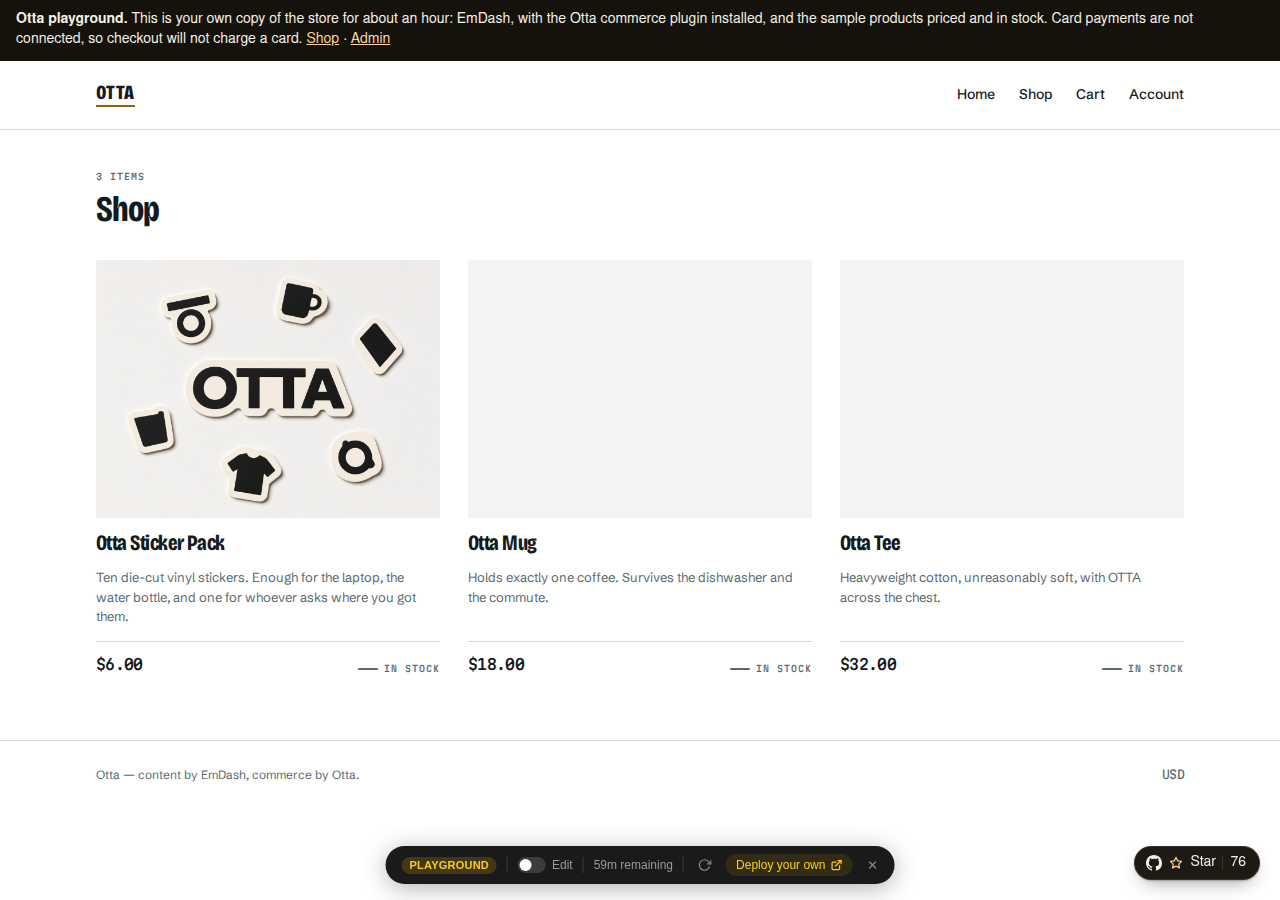
- In the browser. Open the playground at try.otta.sh/playground. It is a disposable store that lasts about an hour and signs you in as admin. Card payments are not connected and no email is sent.
- On your Cloudflare account. Click Deploy to Cloudflare. It copies the template to your GitHub account, deploys one Worker to your Cloudflare account and gives you a setup link to claim the store. EmDash Store Template: Deploy to Cloudflare in One Click walks through it.
- Locally. With Node.js and pnpm, run the README’s quick start. It starts the repository’s reference site, a default EmDash site with Otta installed. Claim the store with the setup link the dev server prints:
git clone https://github.com/UrumiAI/otta.sh && cd otta.sh
pnpm install
pnpm --filter @urumi.ai/otta-site-staging exec emdash secrets generate --write .dev.vars
pnpm --filter @urumi.ai/otta-site-staging dev
Appendix: our Workers import test
We wanted to see where the runtime boundary sits, so on 2026-11-21 we tried to start a Worker that only imports Medusa. It did not start. Medusa does not claim Workers support, so this was the expected result. It is not evidence about Medusa’s quality, and it is not a Medusa defect: it only shows that Medusa’s backend and the Workers runtime are different shapes.
Setup: @medusajs/medusa and @medusajs/framework 2.23.0, Node 22.22.2, wrangler 4.166.0, nodejs_compat on. The Worker’s only job was to import Medusa’s MedusaAppLoader.
- Bundle without workarounds: it failed.
wrangler deploy --dry-runcould not resolvemariadb/callback,better-sqlite3orlibsql, three optional database drivers pulled in by Medusa’s ORM (MikroORM). - Add our own workaround: three aliased stubs. We pointed each of those three modules at an empty file with an
[alias]block inwrangler.toml. That is our change, not something Medusa supports. With it, the bundle built: wrangler reported "Total Upload: 13787.02 KiB / gzip: 2327.81 KiB". - Start it in local
wrangler dev: it failed at startup. The runtime refused to run code that generates random values in global scope. The call wasrandomUUIDin@medusajs/telemetry, which Medusa’s logger loads when the module is imported.
Output of step 3 (2026-11-21, trimmed):
✘ [ERROR] service core:user:medusa-workers-test: Uncaught Error: Disallowed operation called within global scope. Asynchronous I/O (ex: fetch() or connect()), setting a timeout, and generating random values are not allowed within global scope. To fix this error, perform this operation within a handler. https://developers.cloudflare.com/workers/runtime-apis/handlers/

    at null.<anonymous> (node-internal:crypto_random:191:19) in randomUUID
    at null.<anonymous> (index.js:225986:79) in createBaseConfig
    at null.<anonymous> (index.js:225981:28) in InMemoryConfigStore
    at null.<anonymous> (index.js:227108:26) in Store
    at null.<anonymous> (index.js:230908:23) in Telemeter
    at null.<anonymous> (index.js:231067:21) in node_modules/@medusajs/telemetry/dist/index.js
    at null.<anonymous> (index.js:247134:23) in node_modules/@medusajs/cli/dist/reporter/index.js
    at null.<anonymous> (index.js:247483:38) in node_modules/@medusajs/framework/dist/logger/index.js
We stopped there. This was an import test, not a port. A determined developer could patch past this error and find the next one, and a Medusa patch release could move it. The larger obstacle is architectural: Medusa expects two long-running processes plus PostgreSQL and Redis, which is not how a Worker runs.
Reproduce it: the four test files
The whole test is four files:
// package.json
{
  "name": "medusa-workers-import-test",
  "private": true,
  "type": "module",
  "dependencies": {
    "@medusajs/framework": "2.23.0",
    "@medusajs/medusa": "2.23.0",
    "wrangler": "4.166.0"
  }
}
# wrangler.toml
name = "medusa-workers-test"
main = "src/index.mjs"
compatibility_date = "2026-11-01"
compatibility_flags = ["nodejs_compat"]
# Our workaround for step 1: each alias points at an empty module.
# Remove this block and the bundle fails to resolve these three drivers.
[alias]
"mariadb/callback" = "./src/stub.mjs"
"better-sqlite3" = "./src/stub.mjs"
"libsql" = "./src/stub.mjs"// src/index.mjs
import { MedusaAppLoader } from "@medusajs/framework";
export default { async fetch() { return new Response(typeof MedusaAppLoader); } };
// src/stub.mjs
export default {};npm install
npx wrangler deploy --dry-run --outdir out # step 2: bundles with the aliases and prints the size
npx wrangler dev # step 3: fails at startupHow we checked
Every Medusa number in this post was fetched on 2026-11-21:
- Medusa version:
npm view @medusajs/medusa versionreturned 2.23.0. - Stars and release: the GitHub REST API (
https://api.github.com/repos/medusajs/medusaand/releases/latest) returned 37,349 stars and v2.23.0 published 2026-11-20. - Pricing, deployment requirements and the 23 commerce modules: read from the linked Medusa pages, not from search snippets.
- Alternatives table: each row read from the linked vendor page or repository file on 2026-11-21.
- The Workers import test: run locally on 2026-11-21 with the files above. We kept the raw logs of each step; the appendix quotes the relevant lines.
Changelog: 2026-11-21 first published. We will update this post and its date if Medusa adds official support for running its backend on Workers, if Otta reaches 1.0, or if Otta adds regions, price lists or multiple stock locations.
FAQ
Can a Medusa storefront run on Cloudflare Workers?
Yes, but the Medusa backend still runs elsewhere, on Medusa Cloud or a Node host, with PostgreSQL and Redis. Public examples (checked 2026-11-21) include the Astro Medusa Storefront theme, which has a Cloudflare Workers adapter, and Meridian, which runs a Next.js storefront and Payload CMS on Workers. Otta is a different design: commerce runs inside the EmDash CMS on Workers.
Can Medusa run without Redis?
In development, yes: Medusa publishes in-memory and Postgres versions of its event bus, workflow engine and locking modules. For production, Medusa’s deployment guide says "Your Medusa application must connect to PostgreSQL and Redis databases," and uses Redis to store the server’s session. Medusa Cloud’s Develop plan does not include Redis; Launch ($99/month) and above do (checked 2026-11-21).
Is Otta a Medusa replacement?
No, not in general. Otta replaces Medusa only for single-store sites that run on EmDash. It has no regions, sales channels or multiple stock locations, and it is not a commerce API for a separate frontend.
Is Otta headless like Medusa?
Partly. Otta’s storefront routes return JSON view models, but they run as EmDash plugin routes in the same Worker. Otta is built for EmDash sites, not as a commerce API for any frontend.
How much does it cost to run Otta compared with Medusa?
Otta’s template runs on Cloudflare Workers Free at $0 for the Worker, with hard daily limits; R2 needs a payment method, and email to arbitrary customers through Cloudflare needs Workers Paid (from $5/month per account). Medusa Cloud starts at $29/month (600 compute hours), and Launch and Scale bill $0.16 per compute hour past their allowance (checked 2026-11-21). The two are not like-for-like: Medusa Cloud includes managed hosting and support. Neither charges a percentage of sales.
Is Otta production-ready?
Yes. Otta is production-ready today. It is pre-1.0, so pin exact versions and review each update, because APIs and admin screens can change between releases. Stripe card checkout and cash on delivery are covered by the project’s automated tests, and the one-click deploy was verified end to end on Workers Free on 2026-11-10, on EmDash 1.3.1. Open issues include delayed Stripe payment methods (#606) and large variant saves on Workers Free (#637).
Running your site on EmDash? Deploy Otta to your Cloudflare account, try the Otta playground, or read the code on GitHub. Comparing other options? See Otta vs WooCommerce and Otta vs Shopify: total cost.
If this was useful, star the repo on GitHub so other EmDash developers can find it.
About the author: Vedanshu Jain is a former WooCommerce core engineer and tech lead, and builds Otta at Urumi. GitHub · WordPress.org
Last updated Nov 23, 2026