 Urumi.AI
Otta vs Shopify: Total Cost at $10k, $50k and $250k a Year (2026)
Is there a Shopify alternative with lower fees? Otta vs Shopify worked at $10k, $50k and $250k a year. Card fees are identical; the plan fee is not.
Leaving Shopify for Otta saves a flat $288 a year, which is 2.9% of revenue at $10k and 0.1% at $250k. The 2% fee Shopify adds when you use another payment gateway is the only large number in this comparison.
Updated 2026-11-21 · Disclosure: Urumi builds Otta, so the formulas and a 16-line script are on this page for you to check.
Otta is an open-source commerce plugin for EmDash that runs products, cart, checkout, orders and inventory inside the CMS on Cloudflare Workers, with no separate backend, database server or Redis.
Is there a Shopify alternative with lower fees?
Only on the plan fee. Otta with Stripe pays the same 2.9% + 30¢ card rate as Shopify Basic but swaps the $348 yearly plan for $60 of Cloudflare Workers Paid, saving $288 a year while usage stays within Cloudflare’s allowances. That saving is small, so the case for Otta rests on owning the code and running store and content in one deployment.
At every revenue level the whole gap is the plan fee: card fees are identical. At $10k it is 41% of Shopify’s bill ($288 of $698); at $250k it is 3%. On prices checked 2026-11-21, a Shopify Basic store (yearly billing) pays 6.98%, 4.20% and 3.64% of revenue in platform and card fees at $10k, $50k and $250k a year, and an Otta store on Workers Paid pays 4.10%, 3.62% and 3.52%. Run Shopify with Stripe instead of Shopify Payments and Basic adds 2%, which makes the gap $1,288 at $50k (Table G).
Otta is for a store owner who wants the store and the content in one deployment, set up and run with an AI agent. The sections below show what Shopify includes that Otta does not.
Try the Otta playground (a disposable store that lasts about an hour, with no account and no card payments) · Deploy to Cloudflare · Star Otta on GitHub to follow releases on the way to 1.0
Assumptions used in every table
- A US store, prices in USD, every vendor page opened on 2026-11-21. The numbers do not hold for other countries.
- Average order value (AOV) of $50, an illustration rather than a benchmark: $10k = 200 orders, $50k = 1,000 orders, $250k = 5,000 orders a year. Other AOVs are in the calculator section.
- Domestic US cards, paid online, revenue spread evenly over the year. No refunds and no chargebacks.
- Card rates are the published rates, used as the actual rate. Shopify publishes them as "Card rates from 2.9% + 30¢ USD" and Stripe as its standard 2.9% + 30¢; the rate on your own account can differ.
- Shopify: Shopify Payments, no paid apps, Basic billed yearly ($29 × 12 = $348). Monthly billing ($39 × 12 = $468) is shown too. Promotions are shown separately, not in the base case.
- Otta: Stripe’s standard pricing and Cloudflare Workers Paid ($5 a month), because Cloudflare’s email service needs the Paid plan. The $60 buys email only after you set it up: the store template ships with the email binding commented out, so you uncomment it and add a sending domain on Cloudflare. A Workers Free variant is shown, labelled.
- Cloudflare usage stays inside the included allowances. We have not measured Cloudflare usage at these order volumes (requests, D1 rows, KV, images or the every-minute cron), so the Otta figures are $60 a year plus any usage beyond the allowances in Table D.
- Domain, shipping, sales tax and marketing cost the same on both sides, so they are left out. Your time is not left out; it has its own section.
Otta vs a Shopify Basic plan: the short answer in one table
The card fee is identical, so the gap between Otta and a Shopify Basic plan is the subscription minus the Cloudflare bill. In the base case (no promotions) it is $288 a year against yearly billing and $408 against monthly billing at every revenue level, while usage stays inside Cloudflare’s allowances (see assumptions).
Table A. Platform and card fees per year, domestic cards, no apps (prices of 2026-11-21)
| Revenue (orders) | Shopify Basic yearly | Otta + Workers Paid | Saving |
|---|---|---|---|
| $10,000 (200) | $698 | $410 | $288 |
| $50,000 (1,000) | $2,098 | $1,810 | $288 |
| $250,000 (5,000) | $9,098 | $8,810 | $288 |
How each cell is built: card cost is revenue × 2.9% + orders × $0.30, which is $350, $1,750 and $8,750 and is the same on Shopify Basic and on Stripe. Add $348 for Shopify, or $60 of Workers Paid for Otta. The Otta column leaves out your own time to deploy, update and run the store; see Is the saving worth switching for? before reading $288 as the total cost of ownership.
When Shopify costs less or includes more
- If Shopify invites you to its 1% sales credit and you bill monthly. Credits offset your next plan invoices, so on monthly billing they cut year-one cost; at $250k they can bring Shopify Basic below Otta in year one. On yearly billing they land on the year-two invoice. Worked numbers are in Table G.
- If nobody will own the setup and updates. An AI agent can help with this work, but someone still has to hold the Cloudflare and Stripe accounts, set up an email sending domain and approve each update.
- If you need point of sale, an app store, built-in address-based US sales tax, or a support line. See What Shopify gives you that Otta doesn’t.
Table A2. Billing and plan variants (same assumptions)
| Revenue | Shopify Basic monthly billing | Otta + Workers Free (no customer email) |
|---|---|---|
| $10,000 | $818 (saving with Otta Paid: $408) | $350 |
| $50,000 | $2,218 (saving: $408) | $1,750 |
| $250,000 | $9,218 (saving: $408) | $8,750 |
Workers Paid is the like-for-like comparison. On Workers Free, Cloudflare’s email service is unavailable, so an Otta store sends no order emails or sign-in links unless it has another email provider. A Shopify store sends both.
Which Shopify alternatives charge no transaction fee?
On 2026-11-21, WooCommerce, Squarespace Core and Otta charged no platform transaction fee, and BigCommerce charged none when you use one of its embedded payment providers; you still pay your card processor. Shopify Basic adds 2% only when you use a gateway other than Shopify Payments, and Squarespace Basic charges 2% on every online store sale.
"Zero transaction fees" usually means the platform takes no cut while the card processor still charges its rate. Table B prices each plan with the same card cost (2.9% + 30¢, $50 AOV) so the totals compare plan fees and platform fees only.
Table B. Total yearly cost at $10k, $50k and $250k, $50 AOV (vendor pages as of 2026-11-21)
| Platform and plan | Platform transaction fee | Published card rate | $10k / year | $50k / year | $250k / year | Source |
|---|---|---|---|---|---|---|
| Otta + Workers Paid | None; you pay Stripe directly | Stripe 2.9% + 30¢ | $60 + $350 = $410 | $60 + $1,750 = $1,810 | $60 + $8,750 = $8,810 | GitHub |
| WooCommerce (self-hosted) | "0% revenue share" | WooPayments 2.90% + $0.30 (US cards) | $0 + $350 = $350 + hosting | $1,750 + hosting | $8,750 + hosting | Pricing, WooPayments fees |
| Shopify Basic, yearly ($29/mo) | 2% with a third-party gateway; none with Shopify Payments | "Card rates from 2.9% + 30¢ USD" | $348 + $350 = $698 | $348 + $1,750 = $2,098 | $348 + $8,750 = $9,098 | Pricing |
| Squarespace Core, yearly ($29/mo) | 0% | 2.9% + $0.30 | $348 + $350 = $698 | $348 + $1,750 = $2,098 | $348 + $8,750 = $9,098 | Pricing |
| Squarespace Basic, yearly ($19/mo) | 2% | 2.9% + $0.30 | $228 + $200 + $350 = $778 | $228 + $1,000 + $1,750 = $2,978 | $228 + $5,000 + $8,750 = $13,978 | Pricing |
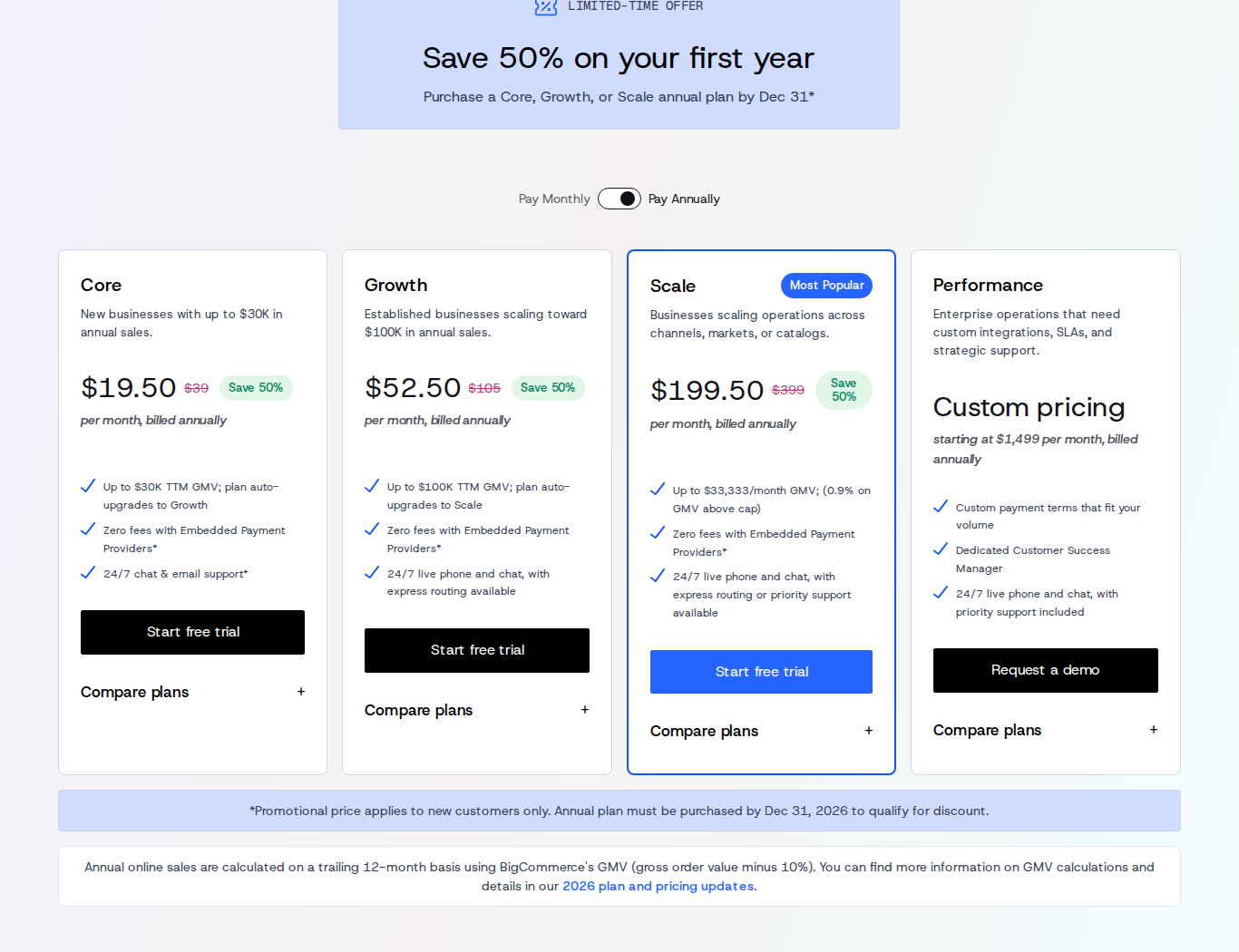
| BigCommerce Essentials, monthly list price | 2.0% Core, 1.0% Growth, 0.6% Scale on non-embedded providers; none on embedded | "begins at 2.89% + $0.29" | Core $468 + $350 = $818 | Growth $1,260 + $1,750 = $3,010 | Scale $4,788 + $8,750 = $13,538 | Pricing |
| BigCommerce Essentials, first-year promo (annual, new customers, bought by 2026-12-31) | as above | as above | Core $234 + $350 = $584 | Growth $630 + $1,750 = $2,380 | Scale $2,394 + $8,750 = $11,144 | Pricing |
How Table B is built:
- Card cost is the same everywhere: revenue × 2.9% + orders × $0.30 = $350, $1,750 and $8,750. BigCommerce’s own published rate (2.89% + $0.29) would make its rows $3, $15 and $75 lower.
- WooCommerce core is "Free, with no monthly subscription", but you pay for WordPress hosting, which we do not price here, so its total is card fees plus your hosting bill.
- BigCommerce caps each plan by trailing-12-month GMV, which it defines as gross order value minus 10%: Core up to $30K, Growth up to $100K, Scale up to $33,333 a month. So $10k uses Core ($39/mo), $50k uses Growth ($105/mo) and $250k uses Scale ($399/mo). The promotional row is the page’s "Save 50% on your first year" price ($19.50, $52.50 and $199.50 a month billed annually); the page states "Promotional price applies to new customers only. Annual plan must be purchased by Dec 31, 2026 to qualify for discount." BigCommerce rows assume an embedded payment provider, so no 2% fee.
- Squarespace’s 2% on Basic is its online store transaction fee; it also lists a separate fee for digital content and memberships, not used here.
Cheapest at each tier: leaving aside WooCommerce, whose total depends on the hosting you buy, Otta on Workers Paid has the lowest total in Table B at all three tiers ($410, $1,810 and $8,810), before your own time. Among hosted platforms, Shopify Basic and Squarespace Core tie on yearly billing ($698, $2,098 and $9,098), and BigCommerce’s first-year promo is lowest at $10k ($584).
Hostinger’s ecommerce builder page also advertises "0% transaction fees" and says "Standard payment processing fees may still apply". Its prices are introductory and differ between its pages, so it is not totalled here.
For the WordPress option in detail, see Otta vs WooCommerce.
What Shopify gives you that Otta doesn’t
Shopify includes managed hosting, a support line, Shop Pay, point of sale, an app and theme store, address-based US sales tax, shipping labels, email marketing and multi-currency selling, none of which Otta provides today. Shopify is a hosted, managed platform; Otta is software you deploy and maintain. Each Shopify item is linked to Shopify’s own page (accessed 2026-11-21).
| Shopify includes | Source | Otta today |
|---|---|---|
| Hosting, upgrades and security run for you | shopify.com/pricing | You deploy, and you merge update pull requests |
| A plan-comparison row labelled "24/7 support", which lists "Live chat" for Basic | shopify.com/pricing | Community issues on GitHub |
| Shop Pay accelerated checkout | shopify.com/shop-pay | Stripe card checkout (Stripe Payment Element) and cash on delivery |
| Point of sale, POS Pro $89/mo per location | shopify.com/pos | None |
| Shopify Tax: address-based US sales tax | shopify.com/tax | Merchant-configured tax rates per zone, plus a replaceable calculator hook |
| Discounted shipping labels | shopify.com/shipping | Shipping rates you configure; no labels |
| Email marketing, up to 10,000 emails a month free | shopify.com/email-marketing | Transactional email only (Workers Paid, after setup) |
| Markets and multi-currency selling | shopify.com/markets | One store currency for every new cart; no currency conversion and no per-market prices |
| Fraud analysis | Shopify Help: fraud analysis | Stripe’s own fraud tools |
| App store and theme store | shopify.com/pricing | No app marketplace; starter storefront |
On currency: an Otta merchant picks one store currency in the admin, and every new cart is created in it. Many currencies can be chosen, including zero- and three-decimal ones, but a product’s currency is fixed once priced, and Otta does not convert prices or show per-country prices, as its deployment guide describes.
Otta is production-ready today. Its own limits, as stated in its README: it is pre-1.0, so APIs, storage shapes and admin screens may change between releases. Stripe and cash on delivery are the only payment options. Payment methods that confirm days later (SEPA Direct Debit, ACH, Bacs, bank transfer) end in an expired order and an automatic refund (issue #606, open on 2026-11-21).
Otta is not a fit if you need point of sale, rely on apps or themes, want built-in address-based US sales tax, or want a support line. We recommend Otta if you already run EmDash or Cloudflare, want content and commerce in one deployment, want to own the code under the MIT license, and Stripe or cash on delivery covers your payments. Start with EmDash ecommerce: how to add a store to EmDash.
What Shopify charges in November 2026
Shopify lists four store plans plus a $0 Agentic plan, and the yearly price is lower than the monthly price on every store plan with a published price. According to Shopify’s pricing page (accessed 2026-11-21), the Basic card rate is "Card rates from 2.9% + 30¢ USD"; the tables use each "from" rate as the actual rate.
Table C. Shopify plans, US online card rates and third-party fees (accessed 2026-11-21)
| Plan | Billed monthly | Billed yearly | US online card rate from (Shopify Payments) | Fee when using another gateway |
|---|---|---|---|---|
| Basic | $39/mo | $29/mo | 2.9% + 30¢ | 2% |
| Grow | $105/mo | $79/mo | 2.7% + 30¢ | 1% |
| Advanced | $399/mo | $299/mo | 2.5% + 30¢ | 0.6% |
| Plus | from $2,300/mo | not shown | 2.25% + 30¢ | 0.2% |
| Agentic | $0/mo | – | "from 2.9% + 30¢ USD online" | not shown |
Shopify describes Agentic as "For selling in AI channels" and says "Only pay when you make a sale". The pricing page does not say that it includes an online store or checkout, so it is not compared here. Shopify also lists a point-of-sale add-on, POS Pro, at $89 a month per location.
The third-party fee does not apply to every order. According to Shopify’s help page on fees (accessed 2026-11-21), there is no third-party fee on Shopify Payments, Shop Pay and Shop Pay Installments, or on manual payment methods such as cash, cash on delivery and bank transfers. PayPal is exempt when Shopify Payments is your main provider. Shopify Payments is only available in some countries.
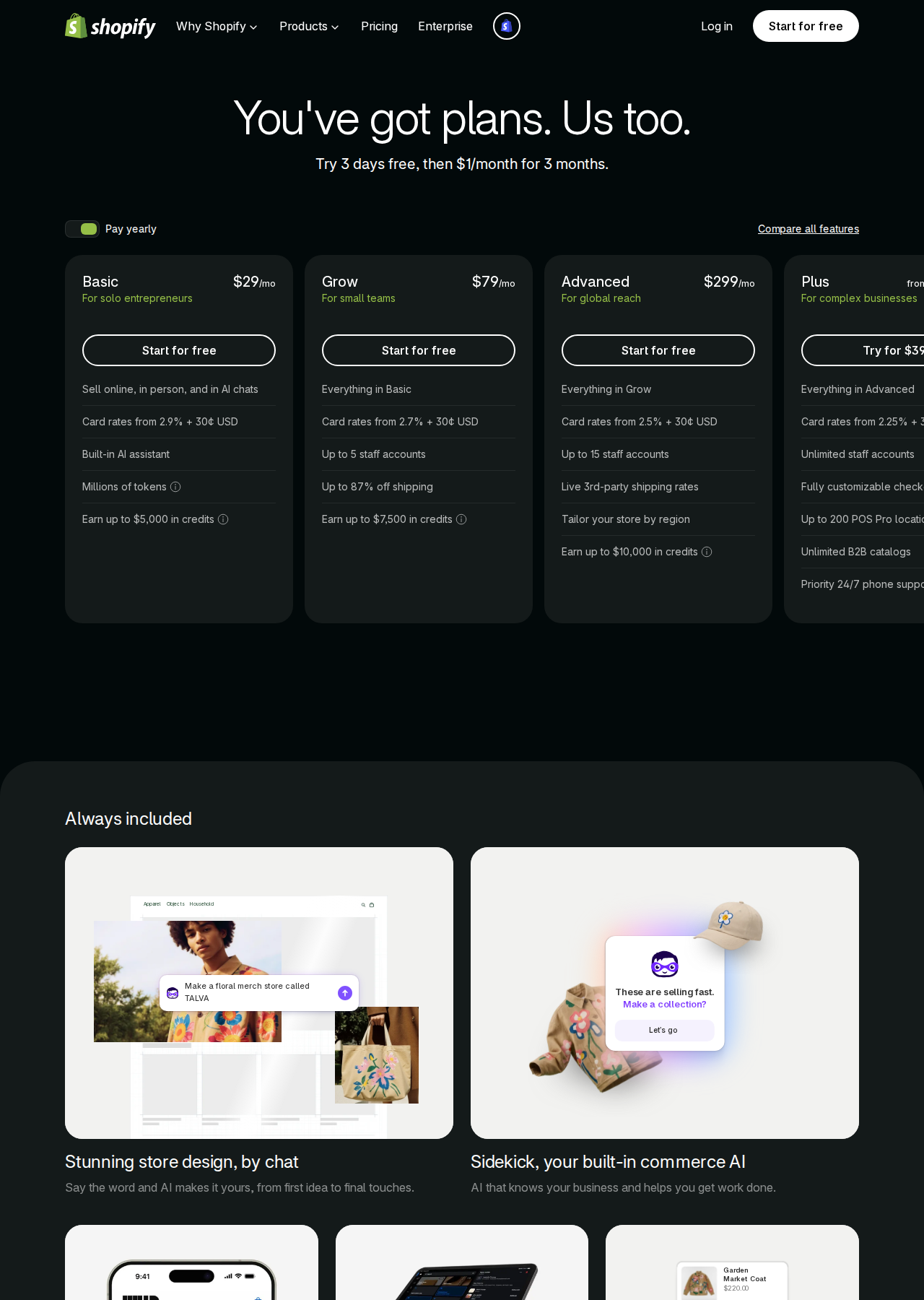
Two promotions, excluded from the base case. The pricing page shows "Try 3 days free, then $1/month for 3 months." The page does not say whether that offer applies to yearly billing; its FAQ says only that "most plans start at just $1 per month for the first 3 months." The page also shows "Earn 1% back on all sales as subscription credits (0.5% on non-Shopify Payments)", up to $5,000 on Basic, $7,500 on Grow and $10,000 on Advanced. The promotion’s terms undercut a common claim that every new store gets this credit:
"Only Merchants who are invited to participate in the Promotion are eligible." — Shopify Rewards Promotion terms (last updated 2025-12-02, accessed 2026-11-21)
How the credit works, from the same terms: it is earned for six months from the day you first select a qualifying plan, at 1% on Shopify Payments transactions and 0.5% on others, and nothing is applied until sales reach $1,000. "Credits will be automatically applied to your upcoming Shopify Service Plan Subscription invoice", "Any unused Credits will rollover into the next month’s invoice", and "Credits can only be redeemed on upcoming Shopify Service Plan Subscription fees." So credits reduce plan invoices, never card fees. With monthly billing they reduce year-one cost; with yearly billing the next invoice is a year away, so they reduce year two. The worked numbers are a separate row in Table G, not part of Table A.
What Stripe charges
Stripe’s standard US rate for domestic cards is 2.9% + 30¢ per successful payment, the same as Shopify Basic’s published rate. According to Stripe’s pricing page (accessed 2026-11-21), there are "No setup fees, monthly fees, or hidden fees."
- International cards: +1.5%.
- Currency conversion: +1%, "if currency conversion is required".
- Disputes: $15 per dispute received. Shopify also charges $15 per chargeback in the US.
- Refunds: the pricing page lists no fee for issuing a card refund, but the original fee is kept. Stripe’s refunds documentation says: "Stripe’s processing fees from the original transaction aren’t returned."
- High volume: "Stripe offers custom pricing for businesses with large processing volumes." Custom rates are not modelled here.
An Otta store connects to the merchant’s own Stripe account with the merchant’s own keys. Otta adds no application fee, platform fee or revenue share; we checked the Stripe adapter in the source code.

What Cloudflare charges for an Otta store
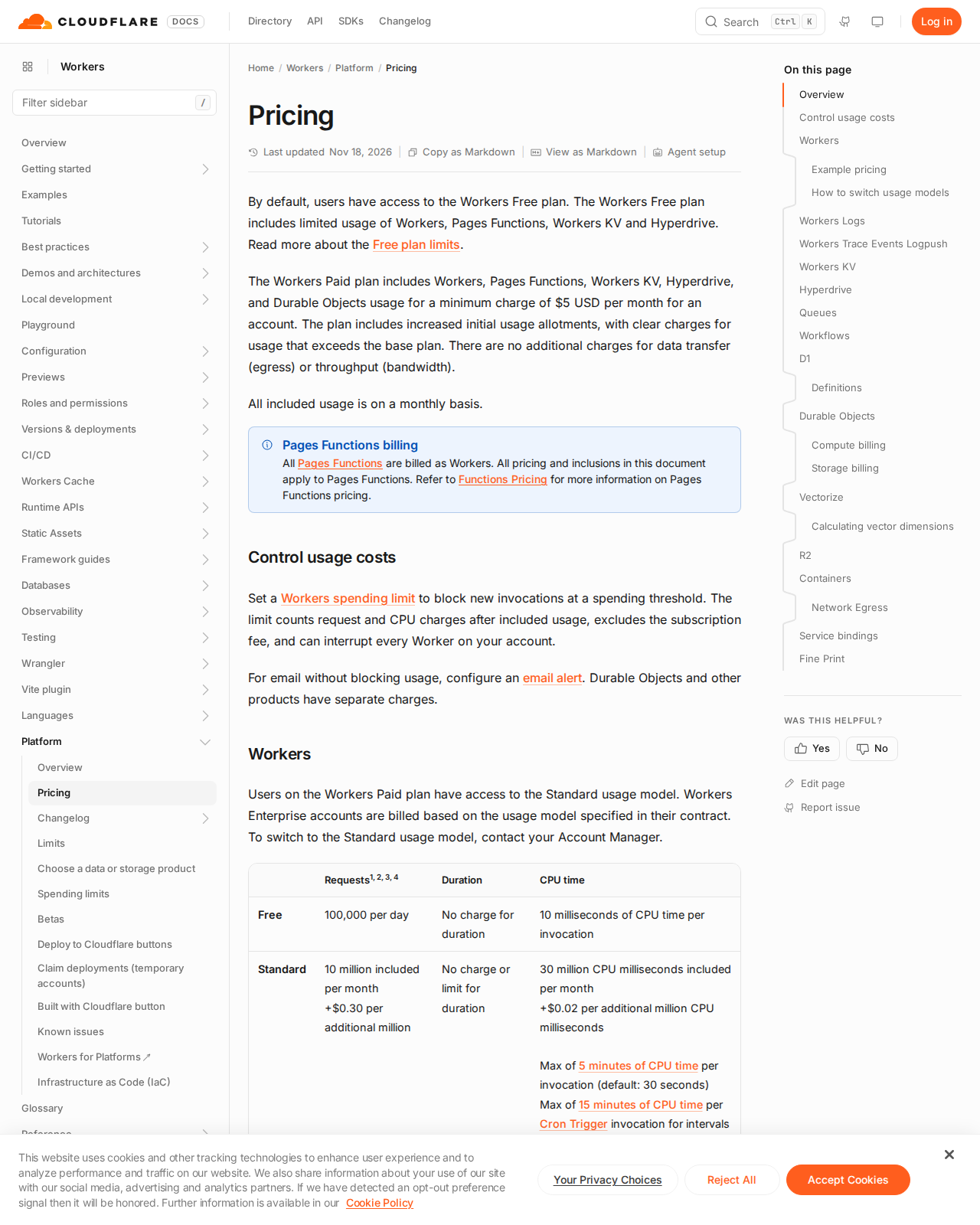
Otta itself costs nothing: it is MIT-licensed software, so the only platform bill is Cloudflare. A store made with the one-click template runs as one Worker with one D1 database, two R2 buckets (public media and private downloads), a KV namespace for admin sessions, an image binding, two rate limits and a cron that runs every minute.
Table D. Cloudflare allowances (accessed 2026-11-21)
| Service | Workers Free | Workers Paid ($5/mo per account) |
|---|---|---|
| Worker requests | 100,000 per day | 10 million per month, then $0.30 per million |
| CPU time | 10 ms per invocation | 30 million CPU-ms per month, then $0.02 per million |
| D1 rows read | 5 million per day | 25 billion per month, then $0.001 per million |
| D1 rows written | 100,000 per day | 50 million per month, then $1.00 per million |
| D1 storage | 5 GB total | 5 GB, then $0.75 per GB-month |
| KV reads | 100,000 per day | 10 million per month, then $0.50 per million |
| KV writes, deletes, lists (each) | 1,000 per day | 1 million per month, then $5.00 per million |
| KV storage | 1 GB | 1 GB, then $0.50 per GB-month |
| Image transformations | 5,000 unique per month; beyond that new ones fail | 5,000 unique per month, then $0.50 per 1,000 |
| R2 (both plans) | 10 GB-month, 1M Class A and 10M Class B operations free per month; no egress charge | same |
| Email to customers | not available | 3,000 per month, then $0.35 per 1,000 |
The every-minute cron is fixed usage you pay for at any sales volume: 1,440 runs a day, about 43,200 a month. It expires stock holds and sends queued order emails, and the template’s config says not to slow it down. We have not measured how many D1 rows a run reads; for scale, Workers Free’s 5 million rows a day works out to about 3,470 rows per run if the cron used it all. The sweep keeps itself to 30 queries per run by default, within Workers Free’s limit of 50 per invocation. Rate-limit bindings are not priced here.
Sources: Workers pricing, KV pricing and Images pricing, all accessed 2026-11-21. On KV’s Free plan, Cloudflare says that once a daily limit is hit, "further operations of that type will fail with an error."
According to Cloudflare’s Workers pricing page (accessed 2026-11-21), the Paid plan has a "minimum charge of $5 USD per month for an account". That $5 covers every Worker on the account, not one store. R2’s free allowance still needs an R2 subscription: Cloudflare’s R2 getting-started guide says "You need a Cloudflare account with an R2 subscription." The R2 prices are $0.015 per GB-month, $4.50 per million Class A and $0.36 per million Class B operations beyond the free allowance.
For email, Cloudflare’s Email Service pricing (accessed 2026-11-21) says "Sending to arbitrary recipients requires the Workers Paid plan." Sends to your own verified addresses are free on every plan, but customers are not verified addresses. That is why the base case uses Workers Paid. Paying for Paid does not switch email on by itself: you uncomment the template’s email binding and add a sending domain on Cloudflare. On the one-click template, Cloudflare Email Sending is the supported route; another provider means replacing the template’s otta() config with your own.
Worked examples at $10k, $50k and $250k
Within Shopify, Basic is the cheapest plan at all three revenue levels on these assumptions; a higher plan’s lower card rate pays back only above about $300,000 a year.
Table E. Yearly cost by plan, yearly billing, $50 AOV (prices of 2026-11-21)
| Annual revenue | Shopify Basic | Shopify Grow | Shopify Advanced | Otta + Workers Paid |
|---|---|---|---|---|
| $10,000 | $348 + $290 + $60 = $698 (6.98%) | $948 + $270 + $60 = $1,278 | $3,588 + $250 + $60 = $3,898 | $60 + $290 + $60 = $410 (4.10%) |
| $50,000 | $348 + $1,450 + $300 = $2,098 (4.20%) | $948 + $1,350 + $300 = $2,598 | $3,588 + $1,250 + $300 = $5,138 | $60 + $1,450 + $300 = $1,810 (3.62%) |
| $250,000 | $348 + $7,250 + $1,500 = $9,098 (3.64%) | $948 + $6,750 + $1,500 = $9,198 | $3,588 + $6,250 + $1,500 = $11,338 | $60 + $7,250 + $1,500 = $8,810 (3.52%) |
Each cell is plan + percentage fee + 30¢ per order. Percentages are the total divided by revenue. The Otta column excludes Cloudflare usage beyond the included allowances (see assumptions).
When does Grow beat Basic? Grow costs $600 a year more than Basic ($948 − $348) and saves 0.2 percentage points on each sale (2.9% − 2.7%). Breakeven card revenue = $600 ÷ 0.002 = $300,000 a year. Below that, Basic is cheaper. At $250k a store on Grow pays $100 more than on Basic.
Shopify fees calculator: price your own store
You can price your own store in five minutes with last year’s numbers.
- Take last year’s card revenue and order count.
- Card cost = revenue × the plan’s percentage + orders × $0.30.
- Add the plan fee (Shopify) or the Cloudflare bill (Otta: $60 on Workers Paid, plus any usage beyond the allowances).
- Add surcharges: international card revenue × 1.5% on Stripe (Shopify Payments charges its own cross-border fee, which its fees page does not state); currency-converted revenue × 1% on Stripe, or × 1.5% on Shopify Payments for a US store capturing payment in a non-domestic currency with Shopify Markets (Shopify fees help page, accessed 2026-11-21).
- Add apps or extra services per year.
total = plan_per_year + revenue * pct_rate + orders * 0.30 + intl_revenue * intl_surcharge + apps_per_yearThe same arithmetic as a 16-line Node script you can run. Copy it below as calc.mjs, then run node calc.mjs 50000 50:
// Usage: node calc.mjs <annual revenue USD> <average order value USD>
// Prices of 2026-11-21, US store, domestic cards, no apps, no promotions.
const [revenue = 50000, aov = 50] = process.argv.slice(2).map(Number);
const orders = Math.round(revenue / aov);
const card = (pct) => revenue * pct + orders * 0.3; // Shopify Payments and Stripe use the same formula
const rows = {
  "Shopify Basic, yearly billing": 29 * 12 + card(0.029),
  "Shopify Basic, monthly billing": 39 * 12 + card(0.029),
  "Shopify Grow, yearly billing": 79 * 12 + card(0.027),
  "Shopify Advanced, yearly billing": 299 * 12 + card(0.025),
  "Otta + Stripe + Workers Paid": 5 * 12 + card(0.029),
  "Otta + Stripe + Workers Free (no customer email)": card(0.029),
};
console.log(`$${revenue} revenue, ${orders} orders at $${aov} AOV`);
for (const [k, v] of Object.entries(rows))
  console.log(`${k}: $${v.toFixed(0)} (${((v / revenue) * 100).toFixed(2)}% of revenue)`);
Its output for node calc.mjs 50000 50 (Node, run 2026-11-21):
$50000 revenue, 1000 orders at $50 AOV
Shopify Basic, yearly billing: $2098 (4.20% of revenue)
Shopify Basic, monthly billing: $2218 (4.44% of revenue)
Shopify Grow, yearly billing: $2598 (5.20% of revenue)
Shopify Advanced, yearly billing: $5138 (10.28% of revenue)
Otta + Stripe + Workers Paid: $1810 (3.62% of revenue)
Otta + Stripe + Workers Free (no customer email): $1750 (3.50% of revenue)
Output for node calc.mjs 10000 50 and node calc.mjs 250000 50
$10000 revenue, 200 orders at $50 AOV
Shopify Basic, yearly billing: $698 (6.98% of revenue)
Shopify Basic, monthly billing: $818 (8.18% of revenue)
Shopify Grow, yearly billing: $1278 (12.78% of revenue)
Shopify Advanced, yearly billing: $3898 (38.98% of revenue)
Otta + Stripe + Workers Paid: $410 (4.10% of revenue)
Otta + Stripe + Workers Free (no customer email): $350 (3.50% of revenue)
$250000 revenue, 5000 orders at $50 AOV
Shopify Basic, yearly billing: $9098 (3.64% of revenue)
Shopify Basic, monthly billing: $9218 (3.69% of revenue)
Shopify Grow, yearly billing: $9198 (3.68% of revenue)
Shopify Advanced, yearly billing: $11338 (4.54% of revenue)
Otta + Stripe + Workers Paid: $8810 (3.52% of revenue)
Otta + Stripe + Workers Free (no customer email): $8750 (3.50% of revenue)The fixed 30¢ matters more for small orders. AOV changes the card cost but not the $288 gap, because both sides pay the same 30¢.
Table F. Effect of average order value at $50,000 a year
| AOV (orders) | Card cost as % of revenue | Shopify Basic, yearly | Otta + Workers Paid | Gap |
|---|---|---|---|---|
| $25 (2,000) | 4.1% | $2,398 | $2,110 | $288 |
| $50 (1,000) | 3.5% | $2,098 | $1,810 | $288 |
| $100 (500) | 3.2% | $1,948 | $1,660 | $288 |
When the gap grows or shrinks
The flat $288 gap changes when payment methods, promotions or extra services differ between the two sides. These rows are at $50,000 a year unless stated, and were calculated by hand, not by the script.
Table G. Sensitivity (prices of 2026-11-21)
| Scenario | Shopify Basic | Otta + Workers Paid | What changes |
|---|---|---|---|
| Base case (yearly billing) | $2,098 | $1,810 | Gap $288 |
| Shopify with a third-party gateway (for example Stripe directly) | $348 + $1,750 + 2% × $50,000 = $3,098, plus the gateway’s own fees, equal on both sides | $1,810 | Gap = $1,000 fee + $288 plan = $1,288. Applies only where Shopify Payments is not available in your country or you need a specific gateway. |
| 20% of revenue needs currency conversion | +1.5% × $10,000 = +$150 (US rate when you capture payment in a non-domestic currency with Shopify Markets; the help page says the fee "is included in your customer’s price") | +1% × $10,000 = +$100 | Stripe is $50 cheaper here |
| Cash on delivery orders | No processing fee; no third-party fee on manual methods | No processing fee; built in | No difference |
| Shopify’s 1% sales credit, if invited, yearly billing | Credit of $50 / $250 / $1,250 at $10k / $50k / $250k (1% of the half-year’s Shopify Payments revenue). It lands on the year-two invoice, so year one stays $698 / $2,098 / $9,098 | $410 / $1,810 / $8,810 | Year one: gap unchanged. Year two: the credit covers $50 / $250 / $348 of the $348 plan, and at $250k the rest rolls over into later invoices. |
| Shopify’s 1% sales credit, if invited, monthly billing | Credits offset the next monthly invoices. Year one: $818 − $50 = $768 at $10k; $2,218 − $250 = $1,968 at $50k; at $250k the credit exceeds the 11 remaining $39 invoices, so year one falls by $429 to $8,789 and $821 rolls over | $410 / $1,810 / $8,810 | Year-one gap: $358 at $10k, $158 at $50k, and at $250k Shopify is $21 cheaper than Otta |
| Shopify’s $1/month promo on monthly billing | $468 − 3 × ($39 − $1) = $354 plan in year one | – | Monthly-billing gap shrinks by $114 in year one. Not checked for yearly billing; the page does not say. |
| One paid app at $20/month (example price, not an average) | +$240 | Feature may be built in, a plugin, or code you write | Depends on the feature |
| Storefront design | Theme store, free and paid themes | Starter storefront template; design work is a cost on the Otta side | Depends on your design needs |
International cards are not in Table G. Stripe adds 1.5% for cards issued outside the US (+$150 if 20% of revenue at $50k is on such cards), and Shopify Payments also charges a cross-border card fee that Shopify does not state on its fees help page, so we could not put a number on the Shopify side.
The credit rows assume revenue is spread evenly over the year and all of it runs through Shopify Payments (non-Shopify-Payments sales earn 0.5%). The $1 promo and the credit are not combined.
Shopify Tax is another line that only one side carries. According to Shopify’s tax page (accessed 2026-11-21), for stores created on or after May 13, 2026, "Shopify Tax is free on your first $100,000 of lifetime sales"; after that it charges a 0.35% calculation fee (0.25% on Plus) on orders shipped to states where you have turned on tax collection. Stores with more than $25,000,000 in lifetime sales are asked to contact Shopify for pricing, and older stores follow different pricing. Otta has no address-based tax service to compare it with, so neither side is charged for tax in these tables.
Is the saving worth switching for?
For most stores, not on cost alone. $288 a year is 2.88% of revenue at $10k, 0.58% at $50k and 0.12% at $250k, so the saving matters at small revenue and becomes a rounding error as the store grows. The reasons to pick Otta are owning the code (MIT), running commerce inside EmDash, and keeping content and store in one Cloudflare deployment. Lower fees are not the reason.
Your time is the cost Shopify does not bill you for. Use your own rate:
break-even hours per year  = $288 / your hourly rate
break-even hours per month = $288 / 12 / your hourly rate
At an illustrative $50 an hour that is 5.8 hours a year (0.48 hours a month). At $100 an hour it is 2.9 hours a year. These rates are examples, not benchmarks.
Recurring work on an Otta store:
- Reviewing and merging the weekly Dependabot pull requests for Otta’s packages and Wrangler. The template’s README says: "Merging it deploys the update."
- Bumping EmDash, Astro or React by hand when an Otta release moves them. Those upgrades do not arrive as a working pull request, so this is a stated cost, not an occasional one.
- Setting up Stripe keys and webhooks, and, for customer email, the template’s email binding and a sending domain.
- Fixing what breaks, without a support line.
Otta is built to be set up and run with an AI agent, so most of this list does not have to be done by hand. A coding agent such as Claude Code can review the update pull requests, bump versions and work on fixes in the store’s code, and an agent you authorize can create and edit product content with EmDash’s own content tools and use the opt-in @urumi.ai/otta-mcp package to set prices and stock and manage orders, coupons, shipping, tax, reports and settings, with every Otta tool call logged. You still hold the Cloudflare and Stripe accounts, create the keys, webhook and sending domain, claim the admin with your own passkey, and approve what ships.
Does Cloudflare’s free plan cover a store?
A deploy on Workers Free was verified end to end on 2026-11-10 (deploy, storefront, store claim, on the template’s earlier EmDash 1.3.1 release), as recorded in the project README. That is a deploy check, not a load test or a card checkout test, and Cloudflare’s email service is not available on Free.
Limits on Workers Free:
- No Cloudflare email to customers. Without an email provider, order emails wait up to 72 hours and are then skipped, and sign-in links are not sent. On the one-click template, Cloudflare Email Sending is the supported route; another provider means replacing the template’s
otta()config with your own. - R2 needs a subscription on the account (a payment method), even though the free allowance applies.
- Daily caps that fail rather than bill. KV writes are capped at 1,000 a day and new image transformations at 5,000 a month; past a cap, operations fail with an error (Table D).
- Fixed cron usage. The every-minute cron runs 1,440 times a day whether or not anyone shops. We have not measured its D1 reads, and it could take a meaningful share of the free daily allowance on its own (Table D).
- Large variant edits. Dropping or re-adding many sized variants with SKUs in one save fails past about 16 to 20 variants on Workers Free (issue #637, open on 2026-11-21).
We have not measured usage at these order volumes; Cloudflare’s allowances are in Table D, so check your own analytics against them.
More on this in Ecommerce on Cloudflare Workers: Run a Store Step by Step (2026) and The Cheapest Way to Run an Online Store in 2026: What It Costs at Zero Revenue.
Try Otta
If you do leave, we recommend Otta, which we build. Other open-source options exist: self-hosted WooCommerce on WordPress, Medusa (a separate Node.js commerce backend; compared in Otta vs Medusa), and the EmDash commerce plugins Vendwick, DashCommerce, Catalog Studio and Ritely.
About Otta: in its EmDash 1.0 post (2026-09-28, section "A growing ecosystem"), Cloudflare wrote: "Urumi is using their WooCommerce expertise to release EmDash’s first eCommerce plugin."
- Deploy your own store: the Deploy to Cloudflare button copies the store template to your GitHub account and deploys it to your Cloudflare account. Walkthrough: EmDash Store Template: Deploy to Cloudflare in One Click.
- Try the Otta playground: try.otta.sh/playground is a disposable store that lasts about an hour, with no account and no card payments.
- Star Otta on GitHub to follow releases on the way to 1.0: github.com/UrumiAI/otta.sh.
FAQ
Does Shopify charge extra if I use Stripe instead of Shopify Payments?
Yes. Shopify adds a third-party transaction fee of 2% on Basic, 1% on Grow, 0.6% on Advanced and 0.2% on Plus, on top of Stripe’s own fee (Shopify pricing page, 2026-11-21). There is no such fee on Shopify Payments, Shop Pay, or manual methods such as cash on delivery.
Is Otta free, and what do I actually pay?
The software is free and MIT-licensed, and Otta takes no transaction fee. You pay Cloudflare ($0 on Workers Free, or $5 a month on Workers Paid, which Cloudflare’s email service requires, plus any usage beyond the included allowances) and Stripe’s card fees, 2.9% + 30¢ for domestic US cards. Cash on delivery has no processing fee.
Which Shopify plan is cheapest at $250k a year?
On these assumptions, Basic. Grow’s card rate is 0.2 points lower, but its plan costs $600 more a year with yearly billing, so it only pays back above about $300,000 of card revenue.
Can an Otta store run on Cloudflare’s free plan?
A deploy on Workers Free was verified end to end on 2026-11-10, on EmDash 1.3.1; we have not load-tested it at the volumes above or tested a card checkout on Free. On Free, Cloudflare’s email service is unavailable, so order emails and sign-in links need another email provider, and R2 storage needs a payment method on the Cloudflare account.
What do I give up by leaving Shopify?
Managed hosting and upgrades, support, Shop Pay, point of sale, the app and theme stores, Shopify Tax, multi-currency selling, discounted shipping labels and Shopify Email. Otta is production-ready today but pre-1.0, so its APIs and admin screens may change between releases.
Method and limits
- Numbers computed by Vedanshu (Urumi) on 2026-11-21 from the vendor pages listed below, each opened that day. Tables A, A2, E and F were reproduced with the script in the calculator section; Tables B and G were calculated by hand and checked twice. Table D copies Cloudflare’s published allowances.
- US store and USD only. Published "from" and standard card rates are used as actual rates.
- We did not measure Cloudflare usage (requests, D1 rows, KV, images, cron or rate limits) at these volumes; usage beyond the included allowances is not priced.
- International-card surcharges are left out on both sides, because Shopify does not state its cross-border fee on its fees help page.
- Promotions change often. Re-check the vendor pages before you decide. We plan to re-check these prices monthly.
What we did not model: refunds (Stripe does not return the original processing fee), chargebacks ($15 on both), international cards, sales tax tools, your time beyond the formula above, paid apps, themes or design work, WooCommerce hosting, domain, and negotiated rates.
About the author: Vedanshu Jain is a former WooCommerce core engineer and tech lead, and builds Otta at Urumi. GitHub · WordPress.org
Sources (all accessed 2026-11-21)
- Shopify, Plans and pricing: https://www.shopify.com/pricing
- Shopify, Rewards Promotion terms (last updated 2025-12-02): https://www.shopify.com/rewards-promotion/terms-and-conditions
- Shopify Help, Fees and costs (third-party fees, US currency conversion 1.5% with Shopify Markets, cross-border fee): https://help.shopify.com/en/manual/international/pricing/fees
- Shopify Help, Chargeback process: https://help.shopify.com/en/manual/payments/chargebacks/chargeback-process
- Shopify Help, Shopify Payments supported countries: https://help.shopify.com/en/manual/payments/shopify-payments/supported-countries
- Shopify Tax: https://www.shopify.com/tax
- Shopify email marketing: https://www.shopify.com/email-marketing
- Stripe, Pricing: https://stripe.com/pricing
- Stripe Docs, Refund and cancel payments: https://docs.stripe.com/refunds
- Cloudflare, Workers pricing: https://developers.cloudflare.com/workers/platform/pricing/
- Cloudflare, KV pricing: https://developers.cloudflare.com/kv/platform/pricing/
- Cloudflare, Images pricing: https://developers.cloudflare.com/images/pricing/
- Cloudflare, R2 pricing: https://developers.cloudflare.com/r2/pricing/
- Cloudflare, R2 getting started: https://developers.cloudflare.com/r2/get-started/
- Cloudflare, Email Service pricing: https://developers.cloudflare.com/email-service/platform/pricing/
- WooCommerce, Pricing: https://woocommerce.com/pricing/
- WooPayments fees: https://woocommerce.com/document/woopayments/fees-and-debits/fees/
- BigCommerce Essentials pricing: https://www.bigcommerce.com/essentials/pricing/
- Squarespace pricing: https://www.squarespace.com/pricing
- Hostinger ecommerce website builder: https://www.hostinger.com/ecommerce-website
- Cloudflare blog, EmDash 1.0 (2026-09-28): https://blog.cloudflare.com/emdash-cms-plugin-registry/
- Otta README, deployment guide and issues: https://github.com/UrumiAI/otta.sh
- Otta store template README: https://github.com/UrumiAI/otta-store-template
Changelog: 2026-11-21: first published; all prices checked as of 2026-11-21.
Last updated Nov 23, 2026